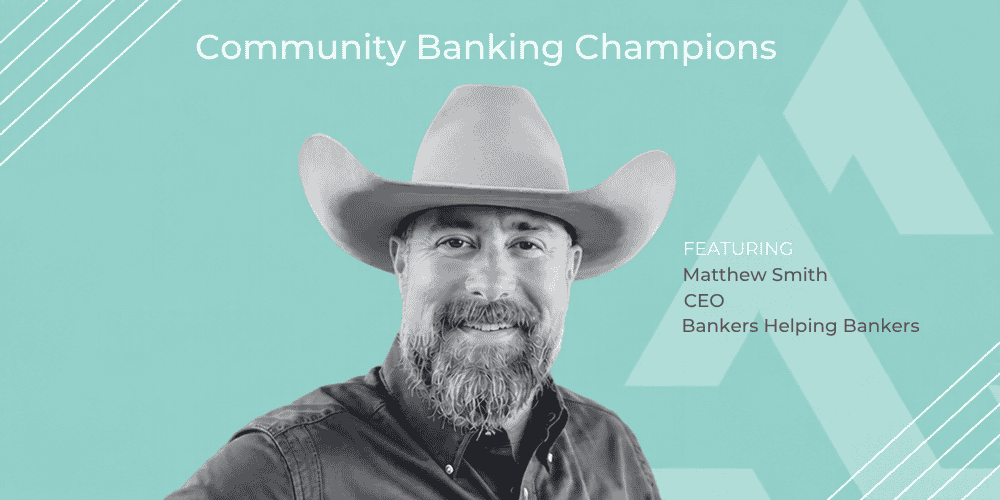
Matthew Smith talks about what it takes to build innovation initiatives that succeed at community banks, and why it starts with “yes.”
Matthew Smith says he wakes up every day and gets to go do the greatest job in the world. As CEO of Bankers Helping Bankers (BHB), he spends his days on the road with community banks and the technology providers who serve them, with one goal: to “quit losing those freaking charters.”
Matthew’s own path is not what you’d expect. He started as a secretary at a community bank in Amarillo, Texas, then moved through deposit operations and into IT. As SVP at Happy State Bank, he helped grow the bank from $750 million to $5.5 billion in assets, leading innovation work that included a bot named Rosie so convincing that branch staff wanted to see where she sat. He went on to serve as Channel Systems Manager at First United Bank, working in digital banking, and as Director of Innovation Initiatives at the Independent Bankers Association of Texas, before becoming CEO of Bankers Helping Bankers. He sat down with us to talk about innovation in banking and why community banks have more people in their corner than they realize.
What do you do as CEO of Bankers Helping Bankers, and what’s the mission?
When I got hired at BHB, I asked, “What is my job description?” They said, “Anytime a bank calls, you pick up the phone and you help them.” That was the only bullet point under my job description.
Our whole thesis is “let’s go out and save community banks.” That’s really what we do at BHB. Everything we do is pro bono. We take all of the banking data that they track at FedFis, and we help community banks make decisions based on that data. It’s not “we think this is where you should go.” It’s “let’s go look at this data, let’s figure out your strategy, and discuss how to go down that path.”
Tanner Mayo, the CEO of FedFis, and I have been visiting banks from coast to coast. This past month, we went from LA to San Diego to Atlanta to Orlando. Just got back from Hutchinson, Kansas.
We need to ensure that we quit losing those freaking charters. So our job is to come in and say, “Let us have a conversation. Let’s see if we can help you find a way to become more profitable.” And if we save community banks, we’re going to save Main Street America, and empower the economy to keep going.
How did your career in banking start?
Are you ready for a crazy story? So I’m 24 years old, and I’m like, good God, what am I doing with myself? I was working as a supervisor at a grocery store, but I knew I didn’t want to work there forever. The hours were really long, and I wanted to be there for my kids. A lady in the bakery had a husband who was working at a local community bank, so I went in for an interview, and the hiring manager said, “I want to hire you.”
For four weeks, I’m picking up this lady’s coffee, her dry cleaning, all the things. One day I said, “Hey Scarlet, am I your secretary?” She always called me sweet baby. She said, “Well, yeah, sweet baby, you’re my secretary. You’re not assistant vice president. You’re assistant to the vice president.”
But every time somebody would go on vacation, I would sit with them for a month before and start learning their desk. So I got to float around every desk within deposit operations and really learn how money flows inside and out of the bank.
Then I went to Happy State Bank as an operations specialist. When I started, it was $750 million in assets and about 15 branches. When I left 12 years later, we were $5.5 billion with something like 80 some odd branches. I’d been through no less than 10 different bank acquisitions, two internet banking conversions, three mobile banking conversions, and a core conversion. So when a banker calls me, I’m like, “Buddy, I probably have been there and done that.”
How did you go from operations into technology?
You’re going to laugh at all these stories. So, internet banking had files that needed to be pushed over to the core, and for some reason they didn’t get where they were supposed to go. I wrote the name of the server down on a little piece of paper, walked back to IT, and said, “Go look on the server and you’ll find the files.” Next thing I know, it makes its way up to the executive leadership team that Matthew from deposit operations was able to communicate with IT. They said, “This guy can bridge the gap between IT and the business.” I spent eight years in deposit operations and then 12 years in IT. So be careful what you do in life. You might start off as a secretary. You might write some stuff down on a piece of paper, and wind up in a whole different department. You don’t know. You just go with it.
What are some of the innovation initiatives you took on?
One of my claims to fame is how I met Tanner. He worked for a company called Malazi that offered mobile banking. One day he called me up and said, “Hey buddy, how would you like to be one of the first banks in the United States to offer an app on the Apple Watch?” I said, “This seems awesome.” He said, “Here’s the kicker, though. Nobody’s got a watch. It’s not even on shelves yet. So there’s no way to go test it.” I said, “Well, this is where I get fired.” And he said, “This is where I get fired as well, but if we pull this thing off, it’s going to be the greatest thing ever.” Thank goodness Tom Shin from Malazi got his hands on one right away and shipped it to us, and we got our little watch app working. How many times do you see a community bank competing with the national banks? That was thanks to Malazi.
After that I got called in on something that, at the time, was artificial intelligence. It was really RPA, robotic process automation. Nobody trusted it. They thought the bot was going to go bananas and take over the world. So we started with an Excel spreadsheet that would take them four days to massage into a report. We took that process from four days down to 30 seconds. All of a sudden everybody’s like, “Wait a minute, what are you doing over there?”
We nicknamed our bot Rosie, after Rosie from The Jetsons. Rosie would come in at night and clean up what nobody wanted to do. When we switched from one core to another, they forgot to switch the flags in account analysis to actually charge customers. What would have taken 30 employees six months to correct this manually, Rosie got done in about five hours. We emailed everyone whenever Rosie did something and made our RPA so human that the sweet ladies at our branch in Olton, Texas, knocked on my office door and said, “Matthew, we want to see where Rosie sits.”
Through RPA, we removed manual processes, brought systems together, and wound up dropping our efficiency ratio by several points. We also built out a data warehouse and our own API layers, and we did our acquisition conversions ourselves instead of hiring the core to do it. We started in 2017. By 2020, I was able to pay for four developers’ full-time salaries with how much money we were saving.
How did you get your bank thinking differently about innovation?
It starts at the top. I worked with a really good executive who came from outside the banking world. He said, “Let me change the way you think. Let’s change the way we solve problems.” He really pulled us outside of our box.
Ultimately, we put together what was called the center of excellence. It was me from IT, three department heads, somebody from the holding company, and we actually had compliance in the room, along with our auditing team. We all raised our right hand and said, “We’re going to solve problems in the right way.” That meant we couldn’t walk into the room and have the answer right away be “no” or “we can’t do that.” What we’ll say is, “Let us understand this better and see if we can get that no to a yes.” And if it is a yes, is it critical, high, medium, or low risk? Maybe I don’t want to do critical risk. Maybe I want to do medium risk.
Then it bled throughout the whole organization. When another department said, “We’re not doing that,” we’d go find a department that said yes. And all of a sudden the department that said no is like, “What are you guys doing over there? I want to be part of the cool kids.”
I can get a group of people together and hear a hundred nos. That’s not what I’m after. I want to hear one yes, and then let’s build upon that. If everybody says no, we’re going to be stuck in our ways. We’re going to go die on a vine.
How do you advise banks on AI now?
I want you to start getting a point of view. I want you to start educating yourself on what’s working for other banks and what’s not, and start creating a task force. You have to get the right-minded people in the room to ask the right questions.
The banks I’m seeing being very successful are finding the low-hanging fruit, the manual processes that are just broken that aren’t going to touch the core. Find some AI tools to start solving those small problems. Instead of asking what did we do wrong, ask what could we have done better? Start off with the small things.
What will it take for community banks to survive this next stage?
It’s vital. If you’re a $500 million bank or under, you’re going to have to find a way to get to a billion dollars in assets. There are lots of ways to get there. You can get involved with embedded finance and become a sponsor bank, for example. Partner up with commercial customers to be your distribution channel.
Partner with a fintech. Community banks, I hope you hear this. Every room I go into, the vendors, Acceleron included, are having conversations about how we help community banks succeed. They’re saying, “How do we help you?”
I want banks to wake up and realize there’s a whole world out there of people who want to help. This is really the magic of Bankers Helping Bankers. I can shoot out an email to 20 bank CEOs, and pretty often 50% of them will email back within a few hours and say, “I would love to help this fellow banker out.” As [the late FedFis Founder] Dave Mayo would say, the world needs more good guys. So go be a good guy, and let’s build out our network.
Acceleron is a modern correspondent banking platform that empowers community banks and credit unions to automate international wire transfers, capture non-interest income, and compete more effectively with big banks. With a foreign exchange (FX) marketplace and currency conversion engine, Acceleron’s API-first infrastructure helps institutions turn cross-border payment flows into efficient, revenue-generating opportunities. Serving over 200 financial institutions and facilitating more than $1 billion in international payments annually, our correspondent banking services and international payment automation solutions are pre-integrated seamlessly with Fiserv Payments Exchange, Aptys, and other leading payments platforms.
Subscribe to our monthly newsletter, "The Exchange," to stay ahead of the curve and get original content and actionable insights you won't find anywhere else!
 Daisy Lin, Head of Marketing, Acceleron
 Daisy Lin, Head of Marketing, Acceleron: 10/27/26, 8:06 AM

 Damon Magnuski, CEO, Acceleron