How wire automation and system integrations mean less manual entry, fewer errors, and more non-interest income for your team
Key Takeaways
-
New software technology can automate international wire processing, significantly reducing manual entry, dual entry, and the errors that come with both.
-
Acceleron already integrates with the platforms your team uses today, so wire data flows through without a second round of keying
-
An FX marketplace leverages competitive bidding to secure better exchange rates, driving down costs for banks and customers.
-
Currency conversion tools give community banks a real opportunity to grow non-interest income through additional fee capture, without adding headcount.
If you're the one re-keying wires twice, this is for you
If you manage wire operations at a community bank, you already know the drill. A wire comes in, you key it into your core or payments platform, then you key much of the same information again into a correspondent bank's portal to actually send it. Two systems, two entries, two chances for a typo, a missed field, or a transposed account number that turns into a phone call two days later.
On top of that, the most profitable part of an international wire, the currency conversion, usually happens at the foreign bank on the receiving end. Your institution collects a wire fee and little else, while the FX spread goes to someone else's bottom line.
New software technology changes both of those problems at once. By automating the wire process, connecting directly to the platforms you already use, and converting currencies upfront, community banks can cut manual work for their operations team while keeping the foreign exchange revenue in house.
This article walks through how a correspondent banking marketplace works, how it plugs into systems like Fiserv Payments Exchange, Aptys, and Braid to eliminate dual entry, and how the customer facing side encourages FX wires over USD so your bank captures more of the transaction. Here is a quick overview:
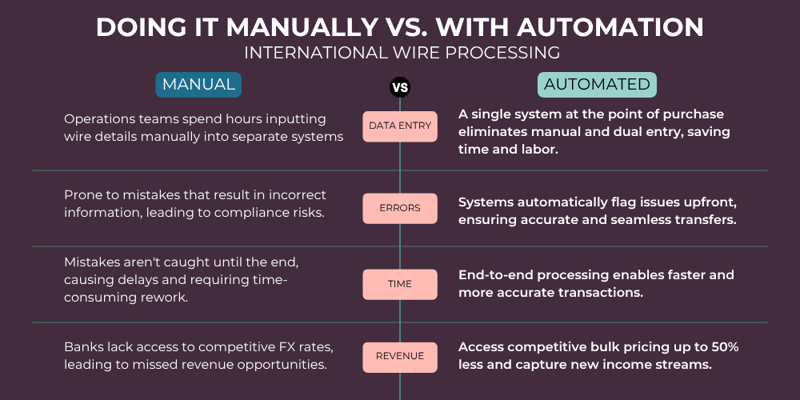
No more dual entry: Acceleron connects directly to the systems you already run
For an operations manager, the real cost of a manual wire process isn't just time, it's risk. Every re-key is a chance to introduce an error, and every error is a chance for a delayed wire, a frustrated customer, or a compliance exception that lands on your desk.
Acceleron is already integrated with the payments platforms most community banks and credit unions run day to day, including:
-
Fiserv Payments Exchange, so wire data initiated in Payments Exchange flows straight into SmartRoute without a second manual entry
-
Aptys PayLOGICS, giving banker's banks and corporate credit unions on the Aptys stack a direct path from initiation to FX pricing without re-keying
-
Braid, extending the same straight through processing to institutions running on that platform
-
Additional core and payments platforms, evaluated on an ongoing basis as more institutions bring specific integration requests to us
Because the integration sits at the platform level, your team doesn't have to open a second portal, copy account numbers by hand, or reconcile two separate input screens. Transaction data moves from your existing system into the FX marketplace automatically, and the wire goes out the door with one entry instead of two.
For operations managers, that translates into a few concrete things:
-
Fewer touchpoints per wire. One entry point means one place for something to go wrong, not two.
-
Faster turnaround. Wires that used to sit while someone manually re-entered data into a correspondent bank's system can move as soon as the rate is confirmed.
-
Less training burden. New staff learn one workflow instead of juggling your core platform and a separate correspondent banking portal.
-
A cleaner audit trail. With one system of record for the transaction, tracing a wire from initiation to settlement is simpler when your compliance team or an examiner asks.
If your institution isn't yet on one of these platforms, our team can still walk through a discovery process to map out the most direct path to reducing manual entry for your specific setup.
Here are some pointers about the advantages of wire automation and what straight through processing solves:
What is a correspondent banking marketplace and how can it help?
A correspondent banking marketplace gets your bank the best pricing on international wires without your team having to shop it manually. When an international wire is initiated, multiple correspondent banks submit bids on the exchange rate, and the best rate comes back in seconds. That competitive environment means better pricing for your customers and a rate your team doesn't have to negotiate by hand.
Acceleron has built two FX tools that help community banks compete with big banks on international payments: an FX marketplace called SmartRoute, and a patented customer interface called NudgeConvert that encourages customers to convert USD wires into FX wires to save money. Converting wires upfront means your bank captures the standard wire fee and the foreign exchange fee, a dual income stream that adds to non-interest income without adding to your team's workload.
Smartroute FX marketplace: sending a wire
To send an FX wire, enter the transaction information. SmartRoute automatically sends the request to its marketplace, where multiple correspondent banks bid on the exchange rate. The best available rate is returned within seconds.
After confirming the rate is acceptable, the wire is sent directly to the receiving bank. Your operations team no longer needs to manually enter transactions into a correspondent bank’s system. Instead, data flows seamlessly from start to finish, reducing manual work, minimizing errors, and preventing delays.
Automated validations during the input process ensure that all necessary information is complete before the transaction is processed. This proactive approach minimizes the risk of errors and avoids the common frustration of delays caused by missing or incorrect information.
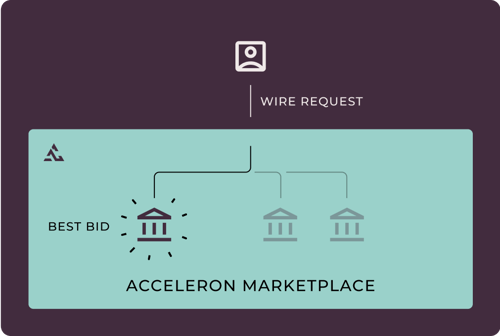
SmartRoute's automated processes
When a transaction enters the SmartRoute system, it undergoes several automated checks to ensure everything is in order:
-
Destination Country Requirements: SmartRoute checks the destination country’s specific requirements, such as the need for a transit code for Canadian dollar transactions. If any required information is missing, the system immediately prompts the user, preventing delays later in the process. Many systems wait until the delivery step before they detect missing information. Nobody wants a call 2 days later asking for what’s required!
-
FX Provider Compatibility: The system automatically narrows down the list of FX providers that can handle the selected currency and country, ensuring that only those capable of processing the transaction participate in the rate auction. Once we've identified providers capable of delivering the payment, we request exchange rates from them instantly via API. We then present only the best available rate, which can be locked in — typically for up to 24 hours. Additionally, the system matches you with correspondent banks that are open to working with a wider range of businesses, offering diverse risk appetites to better suit your specific transaction needs.
-
Risk Management: For higher-risk transactions, SmartRoute can exclude certain FX providers from the auction, protecting your bank’s relationships and avoiding potential de-risking issues.
-
Transaction Information Validation: SmartRoute ensures that all required fields are populated before the transaction proceeds. The data is encrypted from the moment it’s received until it’s sent to the winning provider, and any non-public personal information (NPPI) is deleted immediately after processing to maintain security.
Reconciliation without the spreadsheet chase
For most operations managers, reconciliation is where the manual burden really adds up. At a designated time each day, Acceleron sends a statement summarizing all processed transactions. Each FX provider also sends its own statement independently. If the transaction counts and amounts match, your institution settles with each FX provider directly. Because both statements are generated automatically rather than compiled by hand, your team spends less time chasing down mismatches and more time on exceptions that actually need attention.
NudgeConvert: converting FX payments
NudgeConvert is a customer-facing interface designed to encourage the use of foreign exchange payments instead of USD. When a customer initiates a USD wire to a country like Germany, NudgeConvert informs them of the benefits of sending the payment in the local currency — Euros in this case. This not only ensures that the customer knows the exact amount of the transaction upfront, but it also allows your bank to capture the foreign exchange fees, turning a routine wire transfer into a revenue-generating opportunity.
Behind the scenes, NudgeConvert is powered by an anonymized database that identifies whether the beneficiary’s account is in the local currency or USD. If it’s in USD, the system refrains from sending a nudge to avoid unnecessary prompts.
To prevent customer fatigue, NudgeConvert also allows users to stop the prompts for specific beneficiaries by providing a reason. This ensures that only those interested in FX payments receive nudges, avoiding the risk of over-communication.
NudgeConvert is highly customizable, allowing you to tailor it based on currencies, countries, amounts, originators, and more.
.png?width=500&height=337&name=Customer%20Base%20(1).png)
I'm interested in wire automation - how can I learn more?
If reducing manual entry, cutting dual keying, and capturing more non-interest income sounds like a good fit for your institution, reach out to us directly. We'll walk through your current wire workflow, including which platforms you're already running, and map out the most direct path to straight through processing for your team.
Read more about how we eliminated dual entry for Legacy Bank:
Even if you're not yet integrated with Fiserv Payments Exchange, Aptys, or Braid, our team can run a discovery process to find the fastest way to cut manual work out of your international wire process.
In an increasingly globalized business world, the ability to manage international wire transfers efficiently, while capturing additional revenue and reducing the burden on operations staff, is critical for community banks. Acceleron's SmartRoute and NudgeConvert solutions, combined with direct integrations into the platforms banks already run, give your operations team fewer manual steps, fewer errors, and a clearer path to non-interest income.
Acceleron builds cutting-edge software that allows community banks and credit unions to conduct international payment transactions profitably through a foreign exchange (FX) marketplace. Serving over 160 institutions and facilitating more than $1 billion in international payments annually, Acceleron helps small banks generate non-interest income and compete more effectively with high-fee big banks. Our solutions integrate seamlessly with top payment platforms, ensuring quick implementation and smooth operation.
Ready to cut manual entry out of your wire process? Book a 15-minute meeting to talk through how automation can improve your international wire processing.
 Damon Magnuski, CEO, Acceleron
-1.png)

 Daisy Lin, Head of Marketing, Acceleron: 10/8/26, 11:15 AM