One correspondent bank may not be enough anymore
For many community banks, international payments run through a single correspondent relationship that has been in place for years. It feels stable. It is familiar. And for a long time, it was probably sufficient.
That calculus is shifting.
As commercial clients expand internationally and cross-border activity becomes more common even among mid-sized businesses, a single FX provider creates a quiet exposure: no pricing leverage, no fallback if service degrades, and no ability to optimize by corridor or transaction type.
The question worth asking is whether a single correspondent relationship still serves your clients well, adequately covers your risk exposure, and captures the non-interest income your institution could otherwise be generating.
Single provider payment pain points
One FX provider often seems sufficient early on, particularly for community banks serving local importers, exporters, or clients with straightforward cross-border needs. A single correspondent can handle pricing, settlement, and compliance review without visible friction.
The friction tends to appear gradually. A transaction declined outside the provider's risk appetite. A corridor priced higher than the client expected. A commercial relationship that now requires additional compliance scrutiny. Inbound wires arriving with incomplete data and no clear path to resolution.
These are not edge cases. They are predictable limitations of a single-provider model in which one institution covers every geography, risk category, and pricing environment, with no alternative when its parameters do not fit the transaction.
De-risking adds a more urgent dimension. As large correspondent banks continue to exit smaller institutional relationships, community banks with a single provider face a straightforward vulnerability: when that relationship ends, so does the service. Diversifying across multiple correspondents is not a growth strategy, it is a business continuity imperative.
More on correspondent bank de-risking strategies →
Wire transfer risk appetite is not one size fits all
Community banks increasingly serve a diverse range of commercial clients, from traditional manufacturers to cross-border ecommerce businesses, and companies in emerging sectors that require more nuanced compliance review.
Some FX providers handle straightforward commercial transactions comfortably but decline higher-risk verticals. Others will accommodate those transactions, but at materially wider spreads. A single-channel model forces a choice: decline the business, absorb the margin, or accept pricing that does not hold up competitively.
Routing transactions across multiple providers changes that equation. Lower-risk, high-volume corridors go to the provider offering the tightest spreads. More complex transactions go to the partner best equipped to evaluate that exposure or region. Risk is not increased, it is allocated more precisely.
Acceleron operationalizes this approach through a single platform connected to multiple liquidity providers, including Monex, CXI, Banking Circle, and Corpay, each with distinct risk appetites, regional strengths, and corridor coverage. Each transaction is routed automatically to the provider best matched to its risk profile, corridor, and pricing requirements, within the same workflow the institution already uses. Community banks gain the benefits of a diversified correspondent network without managing multiple portals, relationships, or reconciliation processes, and without concentrating every transaction through a single point of failure.
Gain pricing leverage and non-interest income
Most community banks rely on a single correspondent for international wires, which means they rely on that correspondent's pricing, liquidity depth, and margin structure. There is no benchmark, and no way to know whether they are leaving revenue on the table.
Acceleron's SmartRoute marketplace addresses this directly. By routing each transaction to multiple competing liquidity providers, it creates real-time pricing competition that can reduce FX costs by up to 50%, converting what is typically a pass-through service into a measurable source of non-interest income.
How SmartRoute works →
Improved FX pricing through SmartRoute is one lever. The other is controlling where currency conversion happens.
Most community banks send international wires in USD and leave the currency conversion to the foreign receiving bank, which means ceding the conversion margin entirely. Acceleron's NudgeConvert engine changes that by enabling the sending institution to convert at the point of initiation, capturing the FX spread rather than passing it downstream.
The community FI earns an additional ~1% per transaction on top of the standard wire fee, a meaningful new source of non-interest income that compounds with volume. Here is how the revenue picture compares across three processing models:
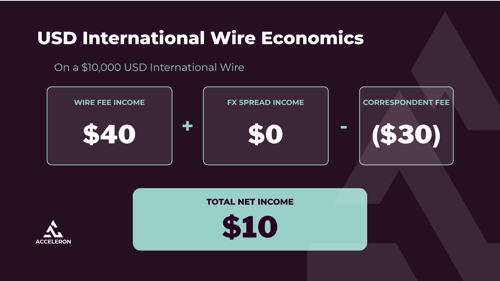
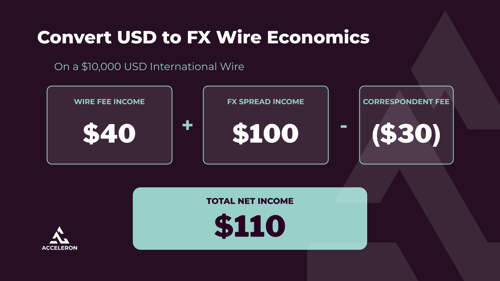
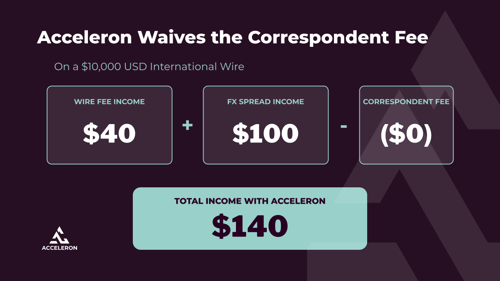
Same wire. Same customer. Same risk profile. Fourteen times the revenue.
That is the practical difference between processing USD-only wires and leveraging Acceleron's full currency conversion capabilities. For a community bank with existing international wire volume, the income potential is immediate and requires no new customer relationships to develop, no additional products to sell, and no additional regulatory exposure.
Read about how NudgeConvert currency conversion works →
Addressing the operational concern
The most common hesitation around working with multiple FX providers is operational. Historically, that meant multiple portals, separate reconciliation processes, duplicate data entry, and added strain on already lean ops teams. The marginal revenue benefit rarely justified the administrative burden.
That tradeoff no longer exists.
Acceleron's platform is pre-integrated directly with Fiserv Payments Exchange, Aptys PayLOGICS, and Braid. Onboarding begins with a dropdown selection inside the payment platform your institution already uses. No additional technical lift. No lengthy implementation. The integrations are already built.
Once implemented, data flows from your existing payment platform to correspondent banks automatically. There is no duplicate entry, no separate portal, and no new reconciliation workflow. The complexity is handled at the infrastructure level, not by your staff.
Learn more about onboarding on the Acceleron platform →
The future of wire transfer automation
ISO 20022 is restructuring data standards. Compliance expectations are rising. Clients want pricing transparency and timing certainty. Boards want non-interest income that does not live and die with rate cycles.
The institutions that will navigate that environment well are not waiting for scale. They are building the right infrastructure now.
A single FX provider made sense when the alternative was manual complexity. It makes less sense when automation handles the routing, integration handles the reconciliation, and a marketplace handles the pricing. The operational hurdles are gone. What remains is the strategic decision.
Acceleron gives community financial institutions the correspondent flexibility, conversion capability, and workflow automation to run a sophisticated international payments operation in-house, without the overhead.
The institutions that move now will be better positioned as client expectations rise and the revenue case for international payments becomes harder to ignore.
Acceleron is a modern correspondent banking platform that empowers community banks and credit unions to automate international wire transfers, capture non-interest income, and compete more effectively with big banks. With a foreign exchange (FX) marketplace and currency conversion engine, Acceleron’s API-first infrastructure helps institutions turn cross-border payment flows into efficient, revenue-generating opportunities. Serving over 200 financial institutions and facilitating more than $1 billion in international payments annually, our correspondent banking services and international payment automation solutions are pre-integrated seamlessly with Fiserv Payments Exchange, Aptys, and other leading payments platforms.
Contact us to get a quick walk-through of how modern correspondent banking tools help 200+ community financial institutions build redundancy and streamline international wire processes:
 Daisy Lin, Head of Marketing, Acceleron


 Daisy Lin, Head of Marketing, Acceleron: 9/29/26, 9:10 AM

 Elizabeth Downey, COO of Acceleron