She asks questions nobody else will ask. Turns out, that's how you end up running the company.
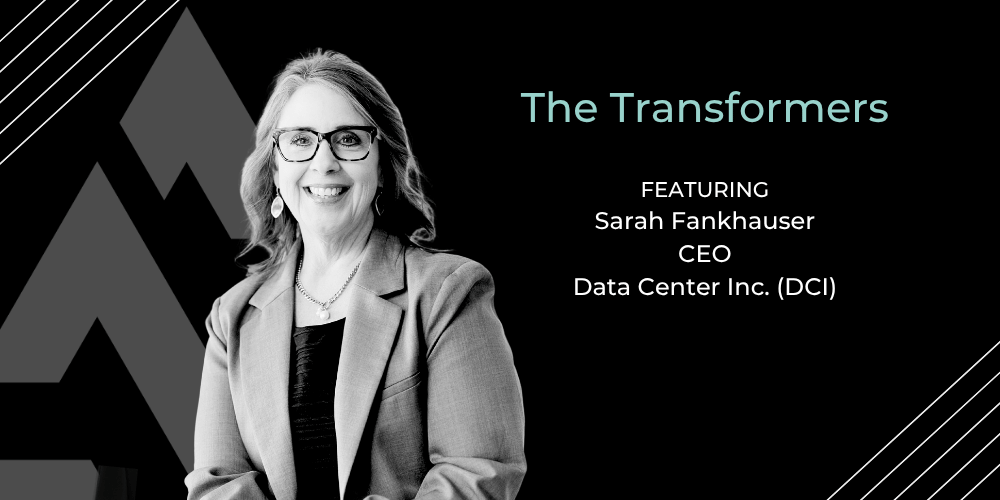
Sarah Fankhauser didn't set out to run a company. She started as a part-time teller while finishing college, as someone who genuinely loved people and happened to love banking. Decades later, she's the first female CEO of Data Center Inc. (DCI), a core and card processor serving community banks from de novos to $5 billion in assets. The through line? The standard she holds her company to is the same one she holds herself to: ask questions nobody else will ask, take on assignments you’ve never tried before, and never rest on your laurels.
We sat down with Sarah to talk about what it actually takes to rise through the ranks, and how DCI is navigating AI without letting it go rogue.
You started as a part-time bank teller. Did you have any sense on day one that you'd end up as a CEO?
No, no. I started as a part-time teller while I was finishing college. I absolutely loved being a teller. I'm definitely a people person, so I loved the interaction, and I loved the banking. Everything just progressed from there.
The bank I started at was actually a DCI customer, and I worked through several different positions there and became a branch manager overseeing operations. Someone I knew at DCI reached out to me and said, "Hey, I'd really love for you to come over and talk to someone here about a position. I just love the story and the people and the company and everything about it.” And that's how I ended up at DCI.
What do you think actually propelled you into the C-suite?
I've always been a person who asks a lot of questions, regardless of my position. When the previous CEO asked me to run loan development, I said yes, even though I'd spent my whole career on the deposit side and was running customer support. He told me, " If you do this, you'll see the other side of the company. You'll understand the technical side and the loan side, and it'll give you the ability to grasp the entire picture.
When I started running development, I was very transparent. I'm sure a lot of programmers didn't see the vision of me coming over and running that area either. But we worked together, I asked a lot of questions, and I worked hard to learn the area. Even though I couldn't sit down and code, I could still empathize and understand what they were going through. It was probably one of the best things I've ever done. From there, I moved into the COO role, and in 2020, I became CEO.
So the key is always to ask questions and be willing to try new things, and then figure out how to make things run more efficiently. I feel that's really important.
DCI has been around for almost 65 years. How do you keep the company moving forward?
Our differentiator is the way we take care of customers; we're agile, we're able to adjust, just like community banks. So I feel like we're kind of all in that together, helping each other.
One of the things that I'm most proud of is that we've continually reinvented ourselves and figured out a way to be innovative and to look different. We started as a co-op, as a mainframe organization. Today, we're privately held, owned by 32 banks, and we're a client-server-based Oracle database. We've always figured out ways to level up. That's something I talk about a lot in strategic planning with our executive and senior management team: how do we continue to level up every year and be better for our customers?
Right now, that's very much about AI and using tools to become more efficient internally, and ultimately delivering things faster and more efficiently for our customers as well.
How do you think about the AI moment right now?
It's exciting and scary all at the same time. I was at a conference a few months ago, and the person leading the AI session said, "This information is all valid as of today, but in two weeks it'll be stale." That's overwhelming, but it also reminds you of the possibilities.
We use Claude Code in our development and engineering, but it's not vibe coding. It's not a free-for-all. Our chief development officer has set parameters: here's how we use it, never do this, don't go here for information. It helps us be more efficient and move faster, but it's not going rogue.
About two and a half years ago, we put together an internal AI committee with me, the COO, our CFO, our CTO, and not just c-level individuals, but a real cross-section of the organization. We did research, we set standards, we added an AI policy to our employee handbook, and we trained employees on what you can do and what you should never do. For example, don't ever put PII in there. We spent a lot of time getting it right before we opened it up, because we want our employees to take advantage of the efficiencies without getting themselves or our customers into a situation we can’t control.
And I'll say this clearly: AI is going to make us more efficient, and we're going to be able to do more, but it doesn't replace people. It certainly never replaces relationships. Our entire company is built on relationships, internally and externally. So is the banking world.
How do you see international payments evolving?
Payments are huge right now, both domestic and international. It's something all of our banks have to be able to offer, especially as they're moving forward with commercial customers. And payments are getting faster and faster. We have real-time payments, FedNow, and international wires. I think you'll continue to see more enhancements and more features in those arenas. And I do feel like the correspondent banks that are leaning in are looking at things differently and finding ways to offer new services.
Learn more about international wire transfer automation:
What do you think are the most important trends that are reshaping community banking?
The consolidation of banks is troubling, especially for community banks. A lot of times it happens because a bank doesn't have a succession plan in place, or it's a family-owned bank and the family doesn't want to take over. We don't want to continue to see the consolidation of banks. because for many communities, the bank isn't just a service, it is an integral part of the community.
I think we need to think differently and continue to think about ways to stay relevant. One of the areas I'm genuinely excited about is fintech processing. We have the ability to do direct-to-core for Banking as a Service (BaaS) or for digital branches, which helps our banks be more profitable and have more control of their data. And I talk to customers a lot about this: at the very least, community banks should be researching it, because if you do it right, it could be a game-changer or a real new revenue opportunity.
I have community banks that feel like they've exhausted their geographic reach, and they don't want to open another brick-and-mortar branch because, frankly, my kids aren't walking into a branch. But spinning up a digital branch and marketing differently? That gives you a completely different reach for new customers. The opportunity is in knowing your customer and offering personalized service that the big banks simply can't replicate.
Any advice specifically for women aspiring to leadership in banking and technology?
Be transparent about where you want to go. I've always been upfront with whoever my supervisor was about wanting to learn more, do more, and grow. Now, that depends on having an open-minded supervisor who's willing to invest in you. But the question I always ask is: wouldn't you rather keep a great employee and help them grow internally than coach them up only to lose them somewhere else?
There's a delicate balance, I know that. If you're assertive as a woman, you can get labeled, and that's real. But I'd still say: if you have the relationship, have the conversation. Tell your supervisor where you want to be. Ask what you need to do to get there.
Acceleron is a modern correspondent banking platform that empowers community banks and credit unions to automate international wire transfers, capture non-interest income, and compete more effectively with big banks. With a foreign exchange (FX) marketplace and currency conversion engine, Acceleron’s API-first infrastructure helps institutions turn cross-border payment flows into efficient, revenue-generating opportunities. Serving over 200 financial institutions and facilitating more than $1 billion in international payments annually, our correspondent banking services and international payment automation solutions are pre-integrated seamlessly with Fiserv Payments Exchange, Aptys, and other leading payments platforms.
Subscribe to our monthly newsletter, "The Exchange," to stay ahead of the curve and get original content and actionable insights you won't find anywhere else!
 Daisy Lin, Head of Marketing, Acceleron


 Daisy Lin, Head of Marketing, Acceleron: 9/29/26, 9:10 AM
 Elizabeth Downey, COO of Acceleron