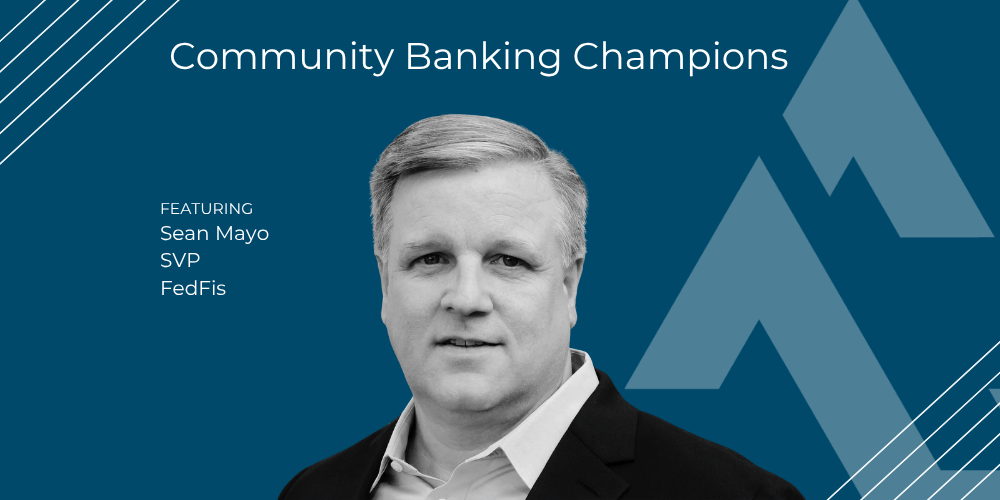
Meet "Uncle Sean," the accountant turned banking and fintech insider behind one of the industry's favorite weekly updates.
If you spend much time around banking and fintech, you probably know Sean Mayo. Or, more likely, you know him as Uncle Sean.
As SVP of U.S. Financial Institutions at FedFis, a banking data company, Sean spends his days looking at bank financials, fintechs, technology providers and the relationships between them. He's also the person behind Uncle Sean's Update, a weekly roundup of banking and fintech news that started as an internal COVID era project and has grown into a newsletter with roughly 18,000 email subscribers.
We talked with Sean about his unconventional path into banking, the family connections that brought him to FedFis, how Uncle Sean's Update and the bad dad jokes came to be, what he's watching in community banking, and some advice he's carried throughout his career.
You started your career in accounting. How did you eventually find your way into banking?
After getting a degree from Texas State University, I did accounting work and financial reporting for about 15 years, changing jobs every couple of years thinking I just didn't like the company or the organization. It took me a long time to understand: no, I didn't like the work. The repetitive nature of it drove me insane.
Eventually I got into the telecom space and moved into consolidated financial reporting, which led into capital raising opportunities. That's where things got interesting. From there I got into risk management and treasury operations, and finally ended up at Samsung, where we were managing about $5.6 billion in receivables, and hedging all of it.
So even though I didn't start in banking, a lot of those early experiences became building blocks for what I do today.
What was it about capital raising and financing that hooked you?
It's the same thing that drives salespeople. It's winning the deal. Overcoming the obstacles, because there's always something in the way, and then actually completing the task.
One of the big ones was Sprint. That took about five years to get done at Samsung, a $700 million to $750 million vendor finance transaction. That was huge, and I learned a lot. It's the passion of wanting to get that win that really drove me in those capital raising transactions.
How did you make the jump from the commercial world into banking and FedFis?
Dave tried to con me into coming to work here for a while, and finally I broke down and said, "Okay, I'll do it."
It's ironic how difficult it is to learn the financial aspect of banking, because banking is really the same as it's been for a long time at its basic conceptual level. You take in deposits, you manage liquidity, and you make loans. Not too different than any other business. You start with a pile of cash and hopefully end up with a bigger one, managing your risk throughout the process.
But banking has changed so much, especially in the last 20 years. Not what we're doing, but the tools we're using and how those tools integrate with each other.
You worked closely with your late brother, Dave Mayo. What did you learn from him?
A lot of people thought Dave was a brilliant financial mind, great on the fintech and vendor space and the technology side. And he was all that. But what people miss is that he was a fantastic bank analyst too. One of the best.
I've been fortunate to learn from some really smart people in my career, Dave being one of them. I'm still learning from people like Rick Boals, who's fantastic at bank financial analysis and relationship building; Robin Fussell, who taught me M&A work and how the call report was structured; and Krissa Coffin, our VP of Product, who's taught me how our products are actually built. It's amazing how much things transcend from one career path into the next.
What do you do at FedFis today?
Rick and I do a lot of specific financial analysis, helping customers who have questions or are getting ready to meet with a bank. I also run a fintech database that was my COVID project and has gone a little crazy. We're tracking a little over 160 sponsor banks and about 715 fintechs. It's easy to capture something once, but maintaining it consistently and reporting on the changes every quarter is the tough part. Back when there were 100 fintechs and 40 sponsor banks, it wasn't a big deal. Now it's a very time consuming labor of love.
And then, of course, there's Uncle Sean's Update.
Tell us the origin story of Uncle Sean's Update.
That started during COVID. When we went fully remote it was tough keeping up with everyone. I felt like we were starting to silo, and I think a lot of organizations felt that way at the time.
So I said, well, I'm just going to voluntarily start doing a weekly report showing the things I thought were cool that week. I threw in some off handed humor to keep it light, because that data can be pretty boring. And I started a section at the bottom: "Dumb stuff Uncle Sean did." Maybe I fell off a ladder, maybe I tried painting and figured out I'm not a painter. There's no shortage of dumb Uncle Sean stuff.
After a couple of weeks, my nephew Tanner [Mayo, CEO of FedFis] called me. "Dude, you've got to start publishing this." I said, "Absolutely not." I was terrified. "I'm an accountant. I don't do marketing content. I'm not a writer." He said, "This is the greatest stuff we have. I'm giving you three weeks and you're going to start publishing this." And the rest is history.
So we can officially blame Tanner for Uncle Sean's Update?
Yeah. He made me do it, so it's all his fault.
Where did the name "Uncle Sean" come from?
I think that's just what I started calling it from the beginning. I've spent so much time in Tanner's life that all his friends called me Uncle Sean. Everybody did. Even Dave, my late brother, would call me Uncle Sean from time to time. It just stuck. And I guess it makes sense. Everybody's got that one crazy, off handed uncle, so everyone can relate.
What's kept you writing it every week for six years?
It keeps us entrenched from a market research standpoint, because there's so much going on in the industry and it evolves so quickly. I spend probably more time on it than I should, but I'm glad some folks find it useful. On the email side alone we're close to 18,000 subscribers now, so it's gotten a little crazy.
What should community bankers be paying attention to right now?
Deposit growth is always a constant conversation. I also see similarities between banking and telecommunications. In telecom there was a strategy to bundle services: landline, then DSL, then cable, internet, eventually wireless. You kept adding to the bundle. We're seeing a similar structure in banking today. On the primary tech stack side, core, online and mobile, we're seeing a lot of bundling. If you have that primary stack locked up, that processor has a strategic foothold that's hard to dislodge.
But what we saw in telecom is that when you bundle services, somebody eventually builds a better mousetrap on the outside. That opens the door for new technology, and we're seeing some of that now with sidecar core products and modern core structures.
It's a constant evolutionary cycle. Very long term core contracts can be tough, and you're seeing guidance now from regulators about whether cores are being flexible enough with community banks or handcuffing them. There's a lot happening in that space.
At the same time, there are emerging technologies creating edge case scenarios. InvestiFi is one that's intriguing, plugging in through the digital side so the customer doesn't have to leave the bank to manage their investments. That's similar to what Acceleron is trying to do on the international payments side: keep the customer and the relationship in the bank, and generate additional non-interest income. Who doesn't love non-interest income?
Learn more about earning non-interest income through international payments:
What do you think about the evolution of international payments?
It's been a while since I've had to do international transactions myself, but the mechanics haven't changed much. Particularly under the Patriot Act, you can't send funds directly to a foreign bank you don't have a relationship with, so the payment hops through a chain of intermediary banks, and even though it's technically a wire, everyone waits for the money ahead of it to clear before passing it along. It could be three or four days for something that should take minutes.
I was talking to the legendary Sarah Beth [Felix, Acceleron’s Co-Founder] not too long ago, explaining how it used to work, and she said, yeah, that's pretty much how it still is, and that's why Acceleron started building a better way to automate and route those payments.
There's a lot of talk about stablecoins and other new rails too, and conversations about FedNow eventually going international. I don't have a crystal ball on how all of that shakes out. But the correspondent banking system as it exists today has a big crack in it, held together with duct tape, bailing wire and bubble gum, so something has to give.
Any personal Uncle Sean advice?
Three things. One, do good work. That doesn't mean don't make mistakes, that's how we learn. My dad used to say some of your best life lessons come from breaking things.
Two, stay inquisitive. Learn new things, put yourself in uncomfortable positions where you don't know what to do, and lean on others for advice. Seek mentorships. That's how you grow.
Three, and this was a big one with my brother Dave: help someone. If you have the opportunity, help someone, even outside the business relationship. We'd have friends or people who weren't even customers come through asking for help with a report, and I'd check with Dave, and he'd always say, sure, as long as we're not spending 600 hours on it. Help them out, because these things come back around.
That leads to the motto that closes out every Uncle Sean’s update?
“The world needs more good people - be one of them.” That's a line from Dave. We were intentional about instilling that in our kids. We'd tell them: the world needs more good guys, just be good, be good people. That's as simple as that.
Acceleron is a modern correspondent banking platform that empowers community banks and credit unions to automate international wire transfers, capture non-interest income, and compete more effectively with big banks. With a foreign exchange (FX) marketplace and currency conversion engine, Acceleron’s API-first infrastructure helps institutions turn cross-border payment flows into efficient, revenue-generating opportunities. Serving over 200 financial institutions and facilitating more than $1 billion in international payments annually, our correspondent banking services and international payment automation solutions are pre-integrated seamlessly with Fiserv Payments Exchange, Aptys, and other leading payments platforms.
Subscribe to our monthly newsletter, "The Exchange," to stay ahead of the curve and get original content and actionable insights you won't find anywhere else!
 Daisy Lin, Head of Marketing, Acceleron
 Daisy Lin, Head of Marketing, Acceleron: 10/8/26, 11:15 AM