FedNow is adding another option to the payments landscape and correspondent banking relationships will be crucial. Here's how to prepare for the next generation of cross-border payments.
The Federal Reserve's announcement that FedNow is preparing to support cross-border payments is an important development for the banking industry. Anything that makes international payments faster, more efficient and less expensive is good news for financial institutions and the customers they serve.
But before we get too excited about the prospect of sending money instantly from a community bank in the United States to a bank in France, it's worth understanding what the Federal Reserve is actually proposing.
FedNow isn't going global. At least not in the way many people might imagine. The distinction matters, particularly for community banks that want to offer better international payment services without taking on unnecessary technology, operational or compliance risks.
What FedNow's cross-border payments announcement actually means
Since its launch in 2023, FedNow has operated as a domestic instant payment network, allowing participating financial institutions to send and receive payments within seconds, 24 hours a day, seven days a week.
In April 2026, the Federal Reserve proposed changes to Regulation J that would allow FedNow participants to use intermediaries, including correspondent banks, to facilitate cross-border transactions. Then, in September, the Federal Reserve announced plans to test new FedNow capabilities that would allow the U.S. portion of an international payment to move faster between participating banks
Here's the important distinction: FedNow will handle the U.S. domestic leg of the transaction. The international leg will continue to move through established correspondent banking arrangements.
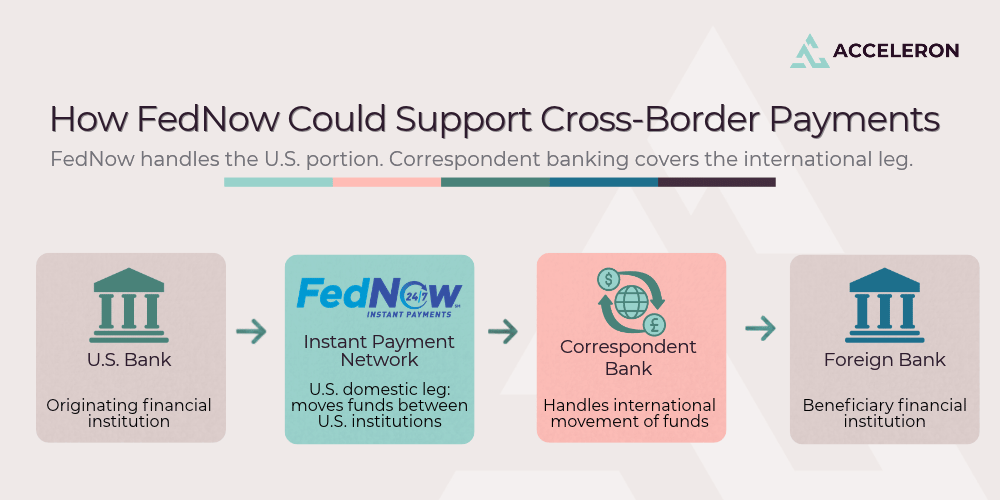
For example, imagine a U.S. business needs to pay a supplier in Germany. The international payment provider and its banking partners would arrange the movement of funds across borders. FedNow could then facilitate the U.S. domestic portion of the transaction, allowing funds to move between participating U.S. institutions in seconds.
The reverse could happen with an incoming international payment. Once the funds reach the U.S. portion of the payment chain, FedNow could facilitate faster delivery to the receiving financial institution.
This is a meaningful improvement in how the domestic and international portions of a payment can work together. But it does not mean FedNow itself will handle foreign exchange conversion, clear payments between countries or replace correspondent banking networks.
The Federal Reserve has said a group of early adopters will test the enhanced message formats, with the opportunity eventually extended to all FedNow participants. The broader regulatory and operational framework is still developing.For community banks, this is something to watch closely, but not something to assume is ready to implement tomorrow.
Faster payments are only valuable if banks can manage the risk
I believe the potential benefits are significant. International payments have traditionally involved multiple institutions, intermediaries and processing steps. Each additional step can introduce delays, costs and opportunities for errors.
A faster domestic payment leg could improve the customer experience, provide greater certainty around payment timing and support use cases such as international payroll, corporate payments, insurance disbursements, property transfers and global treasury management.
But speed introduces a different set of challenges.
Domestic payments and international payments are not the same from a compliance perspective. When a community bank sends money overseas, it needs confidence not only in its own customer but also in the institutions and parties involved in the transaction.
Who is the ultimate sender? Who is the beneficiary? Has the beneficiary been properly identified? Who is responsible for sanctions screening and fraud monitoring? How much confidence does the originating bank have in the foreign institution's Know Your Customer (KYC) procedures?
These questions become even more important when funds settle instantly and are difficult or impossible to recover. With a traditional wire, there is generally more time to review information and address exceptions before a payment reaches its destination. Instant payment rails reduce that window considerably. And ultimately, the originating financial institution needs to be comfortable with the risks associated with the payment. Faster settlement does not eliminate its compliance responsibilities.
This is why I don't believe every international payment should automatically move over an instant payment rail. The better approach is to match the payment method to the risk of the transaction.
Why correspondent banking could become more important, not less
There is a tendency to think that every new payment rail makes the previous one obsolete. I don't see it that way. FedNow, RTP, traditional wires, ACH and eventually other emerging payment technologies are additional tools. Each has different capabilities, costs, settlement characteristics and risk considerations.
The challenge for community banks will be determining which tool makes the most sense for a particular transaction.
Consider a repeat international payment to a known beneficiary. The bank has already established the relationship, collected the necessary information and completed its compliance reviews. If the transaction meets the bank's risk criteria, there may be an opportunity to use a faster payment option.
Now consider a first-time payment to an unfamiliar beneficiary in a higher-risk jurisdiction. That transaction may warrant additional verification and review before funds are released. A traditional wire or another payment method may be more appropriate.
This is where a knowledgeable correspondent bank can provide real value. A strong correspondent banking relationship should be about more than providing access to international banking networks. It should also help community banks navigate the changing payments landscape, understand available options and determine how to use those options safely.
Some banks may have sufficient international volume to establish direct relationships in particular markets. Others may prefer to rely on correspondent partners to handle the complexity of multiple currencies, jurisdictions and payment networks. Neither approach is inherently better. What matters is having the flexibility to support the business your institution wants to pursue.
I also believe community banks should avoid becoming dependent on a single correspondent or technology provider. If a partner exits a market, changes its risk appetite or discontinues a service, that shouldn't bring your international payments business to a halt.
Having multiple options is an important part of managing operational risk and supporting future growth.
Learn more about working with multiple correspondent banking providers through an FX marketplace:
What community banks should be doing now
You don't need to wait for international FedNow capabilities to become widely available to start preparing. In fact, I would argue that the best preparation begins with your domestic instant payment strategy.
Here are four areas I would focus on.
1. Get comfortable with sending, not just receiving, instant payments.
Many institutions initially approached FedNow as a way to receive instant payments. But if you want to participate more fully in the future of faster payments, you need to understand both sides of the transaction.
Evaluate your institution's readiness to send and receive through FedNow or the RTP network. Consider how instant payments will affect your operations, compliance procedures, fraud controls and customer support.
If your institution isn't comfortable sending domestic instant payments, it will be difficult to make the leap to international instant payments.
2. Develop a risk-based approach to payment processing.
Not every payment needs to move instantly, and not every payment should be treated the same way.
Think about how your institution might distinguish between established and new beneficiaries, repeat and first-time transactions, lower-risk and higher-risk jurisdictions, and different payment amounts.
You may want additional verification or review for certain transactions while allowing more straightforward payments to move quickly.
The goal is to build processes that introduce friction when it's warranted without slowing down every customer transaction.
3. Talk to your correspondent banking partners.
Ask your correspondents how they are preparing for the next generation of payment rails. Do they have plans to support FedNow cross-border use cases? What about RTP, stablecoins or other emerging payment technologies?More importantly, can they help you evaluate which options make sense for your institution?
Your correspondent relationships should support your growth strategy, not limit it. Make sure you have partners who are willing to invest in the technology and infrastructure needed to help you serve your customers.
4. Start thinking about the customer experience, not the payment rail.
Most customers don't care whether their money travels over FedNow, RTP, a wire or another network. They care about when it will arrive, how much it will cost and whether they can trust the transaction to get where it needs to go.
I think this is an important shift in how banks should approach payments. Rather than asking customers how they want to send money, ask when they need it to arrive. Is it needed now, tomorrow or in five days?
The financial institution should then determine the most appropriate way to deliver the funds, taking into account speed, cost, compliance and risk. That is a much better customer experience than expecting people to understand the differences between payment networks.
The future is about having more international payments options
I see the FedNow announcement as another step toward a more connected and flexible payments ecosystem. It won't eliminate traditional wires or correspondent banking, and it won't make every international payment instant.
But it does create the potential for community banks to offer faster services and participate in a broader range of payment solutions. The institutions that benefit most won't necessarily be the ones that adopt every new technology first. They'll be the ones that understand how the different options work, have the right partners in place and know how to manage the risks.
At Acceleron, we believe community banks and credit unions should have access to the technology and payment infrastructure they need to grow without having to invest millions of dollars to build everything themselves. Whether that's traditional international payments, FedNow, RTP or emerging technologies, our role is to help institutions take practical steps toward the solutions that make sense for their business.
The future of payments isn't about choosing one rail over another. It's about having the flexibility to get money where it needs to go, when it needs to get there, at the right cost and with the right controls in place.
That's the opportunity community banks should be preparing for.
Acceleron is a modern correspondent banking platform that empowers community banks and credit unions to automate international wire transfers, capture non-interest income, and compete more effectively with big banks. With a foreign exchange (FX) marketplace and currency conversion engine, Acceleron’s API-first infrastructure helps institutions turn cross-border payment flows into efficient, revenue-generating opportunities. Serving over 200 financial institutions and facilitating more than $1 billion in international payments annually, our correspondent banking services and international payment automation solutions are pre-integrated seamlessly with Fiserv Payments Exchange, Aptys, and other leading payments platforms.
Subscribe to our monthly newsletter, "The Exchange," to stay ahead of the curve and get original content and actionable insights you won't find anywhere else!
 Damon Magnuski, CEO, Acceleron

 Damon Magnuski, CEO, Acceleron: 11/17/26, 10:01 AM

 Daisy Lin, Head of Marketing, Acceleron