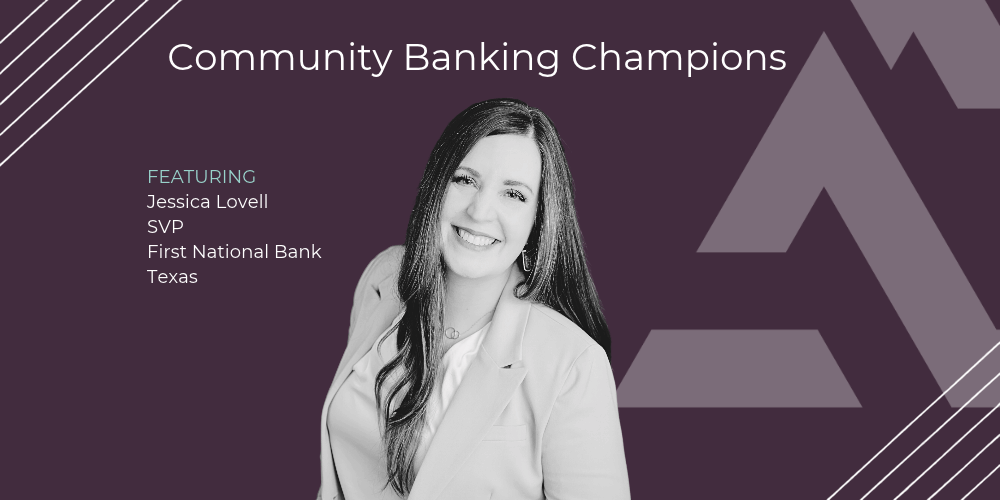
From teenage bank teller to senior leader, and now the keynote stage: why Jessica Lovell believes “we all have an obligation to use our story to help somebody”
Jessica Lovell walked into her first job interview as an 18-year-old with no banking experience, certain she would never get the job. They hired her anyway. Twenty-eight years later, the part-time teller job she expected to be temporary has led to a career as Senior Vice President, Director of Customer Experience at First National Bank Texas. Along the way, she's built a career centered on people, relationships, and service, while helping shape the customer experience for one of Texas's longstanding community banks. A former president of Financial Women in Texas who has also launched a professional keynote speaking career, Jessica talked with us about what nearly three decades in banking have taught her about people, leadership, and finding the courage to share her story.
You started at the bank at 18, right out of high school. How did that happen?
I was working at Mission Taco and I thought, I really don’t think I want to work at a taco joint for the rest of my life. I found a classified ad for a local bank that was hiring and sat in the lobby with all of these professional and poised women. I was rough around the edges, showed up in Nike socks and black slacks, and already ruled myself out. To my surprise, they picked me. I started as a part-time teller.
I come from very humble beginnings. My mother did janitorial work. So did my grandmother. My mother was not in a position to help me with college. And so I really didn't see that that was an option. Starting at the bank changed my life. What I thought was going to be temporary turned into a 28 year career in community banking.
What kept you in the community banking industry?
The people. You spend more time with people at work than you do your own family, and there are women I work with that I love literally like sisters. And the industry gives you the ability to give back. Because of my background, I especially appreciate the opportunity we have to make a difference in people's financial lives. Whether it's helping someone open their first bank account, establish credit, purchase their first home, or just navigate an important financial decision, it's rewarding to know we can play a part in those moments.
You spent 20 years on the front lines of retail banking before moving to a companywide leadership role. What was that leap like?
In 2019, I was approached about an opportunity to serve in a companywide role, which eventually led to the position I hold today. It was one of the scariest career leaps I’ve ever made, but one of the best decisions. It gave me the ability to impact our employees and our customers on a bigger scale. It was like peeling back the curtain and getting to see things I had never been exposed to before. I gained a whole new perspective on how everything we do, from our branches to our digital channels and contact centers, impacts the customer experience.
I'm also incredibly fortunate to lead a team of customer experience experts who genuinely care about our customers and employees. They work hard every day to help resolve issues, identify opportunities to improve, and make sure our customers feel heard. I'm proud of the work they do and the difference they make across our organization.
You’ve built a reputation for connecting with customers. What do customers really want?
Early in my career, I became the person who actually wanted to help the challenging customers, and everybody thought I was crazy. But I learned that sometimes the customers who are the most upset just want someone to listen and help them. I loved being able to turn those situations around and see someone leave with a smile.
What I've learned over the years is that customers want to be heard. They want to trust their financial institution, and they want us to be the experts who can help them navigate their financial needs. I've always said that great customer service is about more than just taking a deposit and sending someone on their way. It's about getting to know your customers, building relationships, and recognizing opportunities to help them with things they may not even realize they need.
Last year, I personally went through more than 20,000 customer survey responses, and two words really stood out to me: trust and family. Customers were saying things like, "I trust you with my money" and "You treat me like family." That's a reflection of the incredible employees we have across our organization who genuinely care about the people they serve. I'm so proud of our bankers and the relationships they build with customers every single day. People can bank anywhere, but it's how you make them feel that keeps them coming back.
How do you turn around a customer who comes in angry?
The first thing I try to do is put myself in their shoes. When someone is upset, the last thing they want is to feel like you're being defensive or dismissing their concerns. I want them to know I'm listening, I understand their frustration, and I'm going to do everything I can to help. I also think it's important to explain what happened and help them understand how we can prevent it from happening again. I want customers to leave feeling informed and empowered, not just that we've resolved their issue.
I've always believed that people tend to match each other's energy. Sometimes something as simple as softening your tone can completely change the direction of a conversation. I've even walked around the teller line to stand beside a customer rather than across from them. It's a small gesture, but it sends a message: I'm with you, not against you.
I remind our bankers that when they're interacting with a customer, they are the bank in that moment. It's important not to take things personally, but to recognize that we have an opportunity to turn a frustrating experience into a positive one.
Is there a customer who changed you?
When I was about 19, I took over a customer, who was known for being pretty difficult to please. She had been a teacher and a coach with everything going for her, then suffered a stroke, and her life changed dramatically. It made her angry. Because of the stroke she couldn’t write, so every month I’d write out her checks and she would sign them. Over time, we developed a really special relationship. I got to know her family, would stop by her house to check on her, and we even participated in a 5K walk together.I know this is not typical for a banker, but that experience taught me a valuable lesson at a very young age: Don’t make assumptions about people. You never know what someone has been through or what they might be going through. Everybody has a story.
A few years ago, you decided to go get your college degree, while working full time and raising your family. Why?
I did some community college right out of high school, and then I went part-time off and on. In 2012 I decided to go back again, but my daughter was eight months old and we had a house fire. We were living in a hotel while I was in school, and I thought, why did I choose now to go back? I finished the semester and stopped for several years. Then in 2019, I only had a little over two years to go, and I said, I’m going to do this.
From 2019 to 2023 I went part-time, and there was no break. I wanted to show my kids the importance of finishing what you start, and the importance of education. But I did it mostly for myself. As a first generation college student, it was important to show myself that I could do it.
For so long, earning my degree was this big goal I had set for myself. When I finally graduated, I was incredibly proud, but I also found myself wondering what was next. I had accomplished something I once thought wasn't possible, and it made me start thinking more about my purpose and how I could use my experiences to make a difference in the lives of others.
You launched Raevolution Speaking this year. What inspired you to pursue professional speaking?
I’ve always had the gift of gab. I inherited that from my mother, and I was the kid who got “talks too much” on her report card. But one of the biggest turning points for me was participating in the Texas Bankers Association's Management Development Program. Through the program, we were challenged to step into situations that made us uncomfortable and vulnerable, and we had to learn to push through that discomfort. It was the first time I really understood the power of vulnerability and how much growth can come from stepping outside your comfort zone.
Later, while serving as president of Financial Women in Texas, I started getting invited to speak at group meetings about resilience, my childhood, and my personal journey. So many people came up to me saying things like, “I had a childhood like yours. I feel seen.” That’s when I started realizing how much sharing our stories can impact other people.
Then I spoke at Texas Tech, and afterward, one of the students sent me a message that changed my life. She said I gave her permission to navigate her life in a way that might not look like everybody else’s. I’d been thinking about pursuing professional speaking, but I kept telling myself, “Maybe next year.” When I realized I could make that kind of impact simply by sharing my words and experiences, I knew I couldn't keep putting it off.
I told her, "You may think I helped you, but your message changed my life." It's amazing how sharing your story can impact someone else, and in return, their story can impact yours.
You’ve said perfectionism isn’t a superpower. What do you mean?
I used to wear it as a badge of honor. What I realized is that perfectionism is fear wearing a productivity costume. It held me back. I wouldn't take risks unless I was confident I could succeed. I would hesitate to speak up or answer a question unless I was 100% sure I had the right answer. I was so afraid of getting something wrong that I was missing opportunities to grow.
Saying yes to serving as president of Financial Women in Texas was one of my first big leaps. I almost said no, not because I didn’t think I was capable, but because I knew I couldn’t do it perfectly.
But every time you take a step in courage, it creates experience, and that experience creates confidence. The worst that can happen is you make a mistake, you learn from it, fix what you can, and move on.
What has Financial Women in Texas meant to you?
The first event I attended in 2019 was their annual conference. The moment I walked into that room, I knew, these are my people. We speak each other’s language, and we allow each other to make mistakes out loud without fear of judgment.
Financial Women in Texas truly changed my life. Saying yes to serving as president was a huge step into the unknown for me. I didn't have all the answers, and that was uncomfortable. But I had this incredible community of women who believed in me, encouraged me, and reminded me that I was capable. That experience built my confidence in a way nothing else had and showed me just how powerful it is to have people in your corner. When you have more women who believe in you than you believe in yourself, how can you say no?
Anything else you want to leave readers with?
Vulnerability and courage are what changed my life. I've learned that it takes courage to put yourself out there, whether that's stepping into something uncomfortable or being willing to share your story. You never know what somebody else is going through, and sometimes just saying out loud what they're thinking can make them feel seen and realize they're not alone. I think we all have an obligation to use our story to help somebody. I’ll do that until the day I die. It’s ingrained in me from my mother. I have a servant heart.
Acceleron is a modern correspondent banking platform that empowers community banks and credit unions to automate international wire transfers, capture non-interest income, and compete more effectively with big banks. With a foreign exchange (FX) marketplace and currency conversion engine, Acceleron’s API-first infrastructure helps institutions turn cross-border payment flows into efficient, revenue-generating opportunities. Serving over 200 financial institutions and facilitating more than $1 billion in international payments annually, our correspondent banking services and international payment automation solutions are pre-integrated seamlessly with Fiserv Payments Exchange, Aptys, and other leading payments platforms.
Subscribe to our monthly newsletter, "The Exchange," to stay ahead of the curve and get original content and actionable insights you won't find anywhere else!
 Daisy Lin, Head of Marketing, Acceleron
 Daisy Lin, Head of Marketing, Acceleron: 11/12/26, 11:00 AM