The latest developments in cross-border payments and correspondent banking
Cross-border payments are entering a new phase. In the first months of 2026, central banks are testing tokenized settlement platforms, global banks are deepening blockchain integration, stablecoin infrastructure is moving into core banking systems, and card networks are expanding direct connections into wallet ecosystems. None of this replaces correspondent banking. But it does raise the bar. In this quarter’s Global Correspondent Banking Monitor, we break down what these developments mean for community financial institutions and how to modernize correspondent banking infrastructure to protect and grow non-interest income.
1. Central Banks Step Up Testing of the Project Agora Cross-Border Payments Platform
Top global central banks are moving into the next phase of testing a closely watched cross-border payments initiative known as Project Agora, coordinated by the Bank for International Settlements. The project brings together major central banks from Europe, Japan, Korea, Mexico, and others, alongside more than 40 commercial banks, including participation from the Federal Reserve Bank of New York. The expanded user testing will have a structured testing window and is expected to run for several months. The goal is to test how tokenized central bank money and commercial bank deposits could operate on a shared programmable platform to make cross-border payments faster, cheaper, and more transparent.
Project Agora is designed to address long-standing frictions in correspondent banking chains, where multiple intermediaries, time zone gaps, compliance checks, and liquidity constraints create delays and added costs. While not a retail CBDC effort, the initiative reflects growing central bank interest in wholesale digital settlement models and tokenized infrastructure as a potential future backbone for international payments.
Impacts on community banking
For community banks, developments like Project Agora signal that the infrastructure of cross-border payments is evolving at the top of the system. Even if smaller institutions are not direct participants, changes in wholesale settlement rails can influence correspondent relationships, liquidity models, FX pricing, and expectations around payment speed and data transparency. As central banks experiment with tokenized settlement and programmable money, community financial institutions will need to ensure their correspondent banking partners and technology platforms can adapt to richer data standards and more real-time settlement environments.
In practical terms, this reinforces the importance of automation, ISO 20022 readiness, and flexible correspondent banking strategies. If wholesale rails become faster and more data-rich, banks that still rely on manual workflows and fragmented FX processes could face widening efficiency gaps. Modern cross-border capabilities will increasingly depend not just on access to a correspondent, but on the ability to plug into next-generation settlement frameworks as they mature.
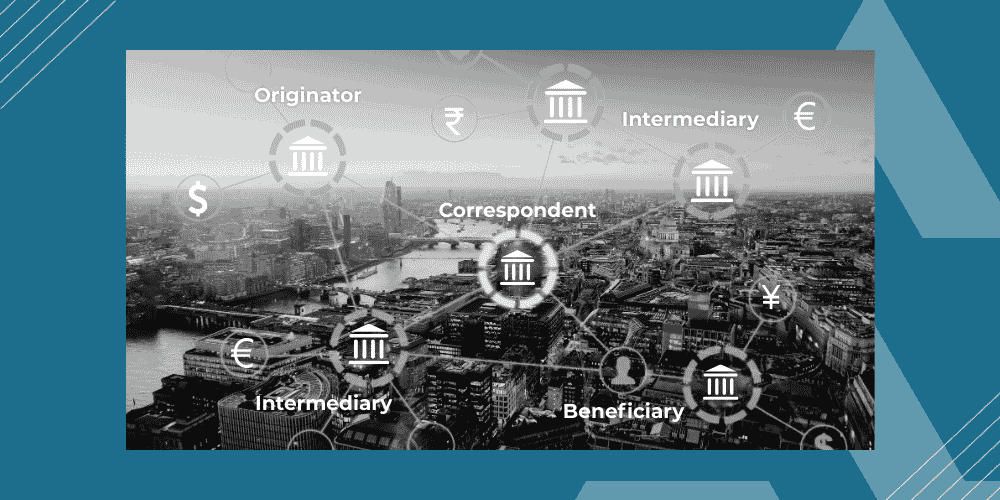
Read more about the difference between correspondent and intermediary banks and how to compress multi-layer correspondent banking chains for more non-interest income:
2. Germany’s Largest Commercial and Investment Bank Expands Use of Ripple’s Payment System for Cross-Border Payments
Deutsche Bank is expanding its use of Ripple technology to enhance cross-border payment capabilities. The move builds on years of experimentation with distributed ledger technology and reflects continued interest among global banks in improving settlement efficiency, transparency, and liquidity management through blockchain-based infrastructure.
While Ripple has long positioned itself as a bridge between crypto networks and traditional financial institutions, the continued expansion of its use by a major global bank reinforces that blockchain-based rails are increasingly embedded within regulated banking environments. Rather than replacing banks, these systems are being integrated into existing frameworks to modernize cross-border flows while maintaining compliance oversight. At the same time, Deutsche Bank is also participating in SWIFT’s global payments blockchain ledger initiative.
Impacts on community banking
For community banks, this signals that blockchain adoption is no longer theoretical or limited to fintech startups. When globally systemic institutions deepen their use of distributed ledger infrastructure, expectations around speed, transparency, and cost efficiency begin to shift industry-wide. Community financial institutions may not implement blockchain directly, but they will feel its influence through correspondent partners, FX pricing models, and customer expectations for faster international transfers.
This reinforces the importance of working with correspondent banking and technology providers that can adapt to evolving settlement rails. Even if the underlying infrastructure is blockchain-based, what ultimately matters for community banks is integration, automation, and maintaining competitive non-interest income from cross-border services.
Read more about how community FIs can approach blockchain and tokenized deposits:
3. Anchorage Digital and Jack Henry Offer Stablecoin Services
Anchorage Digital, the first federally chartered crypto bank, has launched stablecoin services that allow licensed international banks to transfer and settle cross-border payments on stablecoin rails, while providing access to regulated issuance, custody, and U.S. dollar settlement infrastructure. At the same time, Stable Sea partnered with dLocal to support low-cost B2B cross-border payments using stablecoin rails.
Distribution is expanding as well. Stablecore has integrated with Jack Henry & Associates, potentially opening stablecoin functionality to more than 1,600 financial institutions operating on that core system. Separately, Fiserv has introduced stablecoin infrastructure initiatives, including its FIUSD framework and real-time digital asset settlement capabilities, positioning tokenized dollar settlement as an option within its broader banking technology ecosystem.
Impacts on community banking
The integration of stablecoin infrastructure into a major core provider expands the technical accessibility of digital asset settlement within traditional banking environments. However, availability does not equal interoperability. While stablecoin partnerships are accelerating and distribution channels are widening, structural challenges remain. Regulatory oversight varies across jurisdictions, compliance frameworks are still evolving, and fragmentation across issuers and blockchains can complicate transaction flows.
In addition, stablecoin settlement does not eliminate all friction. Fiat on and off ramps, FX conversion, liquidity management, sanctions screening, and reconciliation still introduce operational complexity and cost. In many corridors, traditional correspondent rails remain more predictable and deeply liquid, particularly for U.S. dollar settlement.
For community financial institutions, the takeaway is not that participation is urgent, but that awareness is essential. Stablecoins may reduce settlement friction in certain use cases, particularly in emerging markets or high-cost corridors, yet they also introduce liquidity, compliance, reputational, and balance sheet considerations. Community banks may reasonably choose to observe rather than adopt in the near term. Still, monitoring developments allows institutions to evaluate whether tokenized settlement can eventually complement correspondent strategies without undermining deposit stability.
Read more about our partnership with Fiserv:
4. Payments Partnerships Reshape Cross-Border Infrastructure from Payoneer to Thunes
A wave of new partnerships across payment companies and banks is accelerating the modernization of cross-border payments. Cross-border payment fintech Payoneer expanded local collections in Mexico and Indonesia, allowing merchants to receive funds in domestic currency via local rails, reducing reliance on traditional correspondent chains, while Thunes partnered with First Abu Dhabi Bank and Costa Rica’s Banco Cathay to launch real-time mobile wallet-based international transfers.
Instead of relying exclusively on layered correspondent banking relationships, fintechs and global banks are building direct integrations with merchants, local currency collection models, blockchain-enabled settlement rails, and wallet connectivity.
Impacts on community banking
For community financial institutions, this trend does not signal the end of correspondent banking. High-value transactions, complex commercial flows, and the majority of global dollar settlement still move through correspondent networks because of their liquidity depth, regulatory clarity, safety, and interoperability. Correspondent banking remains the backbone of cross-border finance.
What is changing is the expectation around speed, transparency, and cost. As fintech platforms, wallet ecosystems, and card networks improve the customer experience at the edge, community banks must modernize how they execute correspondent banking. Automation, cleaner data, diversified correspondent relationships, and optimized FX spread capture allow institutions to compete effectively while preserving non-interest income. The strategic imperative is to upgrade the technology around correspondent banking so that it becomes faster, more transparent, and more profitable within a payments ecosystem that is increasingly real-time and digitally integrated.
To learn more about international wire transfer automation:
5. Card Networks Expand Cross-Border Rails Through Strategic Partnerships with Tencent and OwTing Group
Mastercard is strengthening its cross-border capabilities through deeper integration with Tencent, enhancing connectivity between Mastercard’s global network and Tencent’s cross-border payment rails, including the widely used Weixin Pay ecosystem. The collaboration expands cross-border acceptance and settlement options for international merchants and consumers, further embedding Mastercard within one of the world’s largest mobile payment environments. By connecting to Tencent’s infrastructure, Mastercard is reinforcing its position in Asian cross-border ecommerce and travel corridors.
Meanwhile, Visa is collaborating with OwlTing Group to launch OwlPay Cash, a remittance application designed to deliver funds in local currency across markets, including Mexico, India, and Colombia, using Visa Direct. OwlTing has partnered with Cross River Bank to manage U.S. regulatory compliance and settlement infrastructure. The model blends card network reach, fintech distribution, and regulated banking sponsorship to enable near real-time cross-border payouts into local ecosystems.
Impacts on community banking
These developments illustrate how card networks are extending beyond traditional card acceptance into full-scale cross-border settlement platforms. Rather than competing solely on interchange, Mastercard and Visa are building direct integrations into wallet ecosystems, mobile super apps, and remittance corridors, capturing both transaction flow and FX economics along the way.
Community banks that depend on manual wire processes or single correspondent relationships may find it harder to compete on speed and pricing in corridors where card network and wallet integrations are gaining share. Preserving non-interest income will increasingly depend on automation, competitive FX management, and partnerships that allow banks to plug into these evolving global rails rather than operate alongside them.
Read about Acceleron’s partnership with Service Credit Union:
Acceleron is a modern correspondent banking platform that empowers community banks and credit unions to automate international wire transfers, capture non-interest income, and compete more effectively with big banks. With a foreign exchange (FX) marketplace and currency conversion engine, Acceleron’s API-first infrastructure helps institutions turn cross-border payment flows into efficient, revenue-generating opportunities. Serving over 200 financial institutions and facilitating more than $1 billion in international payments annually, our correspondent banking services and international payment automation solutions are pre-integrated seamlessly with Fiserv Payments Exchange, Braid, and other leading payments platforms.
Subscribe to our monthly newsletter, "The Exchange," to stay ahead of the curve and get original content and insights you won't find anywhere else!
 Daisy Lin, Head of Marketing, Acceleron


 Daisy Lin, Head of Marketing, Acceleron: 9/29/26, 9:10 AM

 Elizabeth Downey, COO of Acceleron