Your International Wire Process Isn't Broken. It's Just Quietly Expensive.
Ask most operations managers at a community bank or credit union how international wires work today, and you'll get some version of the same answer: it works. Mostly. Nobody's going to call it efficient, but nobody's panicking either.
That's actually the problem. International wire processing is one of the last corners of correspondent banking still held together by manual steps, duplicate data entry, and a fair amount of institutional memory about which fields tend to bounce back. It functions. But it functions the way a lot of legacy processes function: at a real, ongoing cost that never quite makes it onto a line item.
A newer generation of correspondent banking software, connected directly to your core, is built to close that gap. It catches errors before they happen, settles automatically, and turns what's been a manual cost center into something closer to a source of revenue.
The duplicate entry problem
In many setups, a wire gets entered once into the core or bank platform, then entered again, separately, into whatever system handles the FX leg. Those two systems don't talk to each other, so the customer's information, SWIFT or BIC code, beneficiary details, amount, and currency all get keyed twice. Two different people, or the same person twice, at two different points in the process.
Every one of those re-entries is a fresh shot at a typo. A transposed digit in an account number, a mismatched beneficiary name, a wrong BIC code. Any one of these can turn a routine wire into a returned payment, a frustrated customer, and an ops team scrambling to figure out what happened, usually after the money's already moved.
It doesn't have to work this way. When the correspondent banking software is built directly into the core, the teller can capture everything at the point of contact, and that entry carries straight through to settlement instead of getting keyed in again by the back office. Customers leave knowing exactly where their wire stands, and what the conversion rate is, instead of waiting to hear back, and that kind of transparency is hard to deliver when the information has to pass through a second system and a second person first. Here's a comparison in wire flow between a dual entry system, and an integrated system like Acceleron:
.png?width=680&height=428&name=International%20wire%20transfer%20operations%20(1).png)
Errors get caught after submission, not before
The most expensive part of manual processing might be the timing of when errors actually surface. In a lot of legacy workflows, that's after a wire has already been submitted and rejected, which means dealing with a returned payment, a delayed settlement, and a customer asking what went wrong. Catching a formatting error before submission versus after rejection is a completely different cost profile. One's a quick fix. The other's a support ticket, a phone call, and a delay the customer definitely notices.
The specifics vary by destination too, which is part of what makes this so hard to catch manually. A wire to China needs a specific routing code that a wire to Germany doesn't. A wire to France needs an IBAN of an exact length, and one missing digit sends it right back. A teller handling international wires occasionally isn't going to have that logic memorized for every country, and a static form has no idea to even ask. With Acceleron, that validation logic lives in the system itself, automatically checking the right fields based on where the money's actually going. Incomplete or malformed wires get stopped at entry instead of bouncing back days later.
Read more about how we helped Legacy Bank eliminate dual entry:
Reconciliation happens after the fact, not during
Because the wire and FX systems don't connect, reconciliation happens downstream instead of in real time. The bank sends a wire, the FX provider processes it separately, and eventually a statement shows up that has to be matched by hand against internal records. If the numbers line up, great. If they don't, somebody's now digging through two systems trying to trace where things went sideways.
That's manageable at low volume. It becomes a real drag as volume grows, because the reconciliation burden scales with every transaction, while the team doing it usually doesn't. That makes it nearly impossible to grow SMB and treasury services.
Cancellations are harder than they should be
Every ops team has lived this one: a customer submits a wire, then calls an hour later to cancel or change it. In a manual, multi system setup, that turns into a scramble. Where in the process does the transaction sit? Has it already gone to a liquidity provider? Is there still time to pull it back? The honest answer is often "maybe, if we move fast," which isn't a great place to be operating from.
A connected system like Acceleron gives ops staff a clearer path here. Instead of hunting across systems, a dashboard shows exactly where a transaction stands, so a wire that hasn't been sent yet can just be cancelled on the spot. And because most providers don't release funds until later in the day, even a wire that's already gone out usually has a short window where a cancellation can still be caught before it settles.
Redundancy is an operations issue, not just a pricing one
Most conversations about working with multiple FX providers focus on rate competition, and that matters, but it undersells the operational side. When every international wire routes through a single relationship, any disruption on that provider's end becomes your problem too. A delay, an outage, a processing hiccup, and there's no fallback while it gets sorted out.
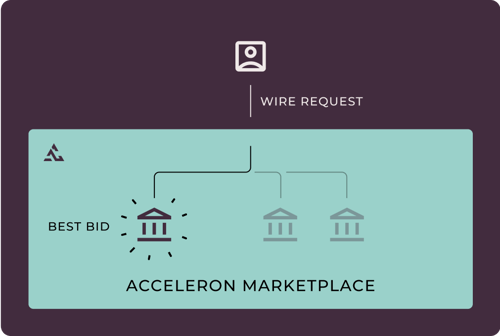
Connecting to more than one provider changes that math. Structured well, transactions can fail over automatically when one provider has an issue, without an ops team needing to notice and manually reroute anything mid day. That's a business continuity benefit as much as a pricing one, and it's easy to overlook until the day a single provider setup actually goes down. Acceleron's FX marketplace is built around exactly this: connecting financial institutions to multiple FX providers who compete for every transaction, building in that redundancy while driving rates down by as much as 50%.
Inbound wires often get less attention than outbound
Most automation conversations focus on outbound payments, but inbound international wires tend to be the clunkier half of the process. Without a clean way to tie an incoming payment to the right originator and beneficiary automatically, inbound wires can land without enough context attached, leaving ops staff to manually chase down where a payment actually belongs before it can even be posted. Acceleron is working to address this problem to make sure inbound payments arrive with the necessary data.
What this actually costs
None of this shows up cleanly on a P&L. It shows up as staff time spent on double entry, as the occasional returned wire that eats an afternoon, as a reconciliation process that quietly needs more headcount than it should, and as customer experience friction that never gets tracked but is absolutely felt. It's easy to underestimate because it's spread across dozens of small frictions instead of one obvious line item.
The fix isn't just automation. It's consolidation.
The real opportunity here isn't simply automating the wire. It's connecting the systems so a wire gets entered once and flows straight through, from initiation to settlement, with validation happening before submission instead of after. That single change collapses duplicate entry, shrinks the reconciliation gap, and turns error catching from reactive to preventive.
This is where pre-built integrations matter more than they might seem to at first. Acceleron connects directly with the platforms banks and credit unions are already running, like Fiserv Payments Exchange, Aptys PayLOGICS, Pathfinder WITS, and Braid, so staff aren't learning a new system or bouncing between two. They stay in the platform they already know, enter the wire once, and it flows straight through to settlement with nothing to re-key on the other end.
It also changes the economics. When international wires run through a connected system like Acceleron with multiple liquidity providers competing for each transaction, banks aren't just cutting operational overhead, they're often improving their FX pricing at the same time, which opens the door to new non-interest income instead of just cost savings. For a lot of community banks and credit unions, that's the more interesting part: a process that used to be a pure cost center becomes a source of margin, without adding headcount or a trading desk.
Read more about generating non-interest income from FX:
Where to start
If you're an operations leader looking at your own international wire process, a few questions are worth sitting with:
-
How many times does the same piece of wire data get keyed in by hand before a payment settles?
-
When a wire gets rejected, is it caught before submission or after?
-
How long does reconciliation take at month end, and how much of that time is manual matching?
-
If a customer calls to cancel a wire mid day, how confident is your team that they can actually stop it?
The answers usually point to the same place: the manual process isn't broken exactly. It's just quietly expensive in a way that's easy to overlook until someone finally adds it up.
Where Acceleron fits in
This is the exact gap Acceleron was built to close. As a platform connecting banks and credit unions to a correspondent banking marketplace, Acceleron plugs into the systems your team already uses so a wire gets entered once, validated against the destination's requirements up front, and settled through one connected flow inside a system your bank or credit union already runs, instead of several disconnected ones. The same connection that fixes the ops friction is what opens the door to better FX pricing and new non-interest income, without adding headcount or a trading desk.
If any of this sounds familiar, the fastest way to know what it means for your institution is to walk through your current setup with our team. We'll look at where your process stands today, where the friction and cost are actually hiding, and what a connected, one system approach would look like for your ops team specifically. Get in touch with Acceleron to set up a 15-minute conversation to get acquainted.
 Daisy Lin, Head of Marketing, Acceleron
-1.png)

 Daisy Lin, Head of Marketing, Acceleron: 9/29/26, 9:10 AM

 Elizabeth Downey, COO of Acceleron