Adding international payments doesn't require coding or a long timeline, thanks to pre-integrated correspondent banking software.
Key Takeaways
-
FX implementation services built for community institutions can go live without any coding or custom development work.
-
Modern foreign exchange platforms plug into core infrastructure your bank or credit union already uses.
-
A short evaluation checklist offers a quick no-code option.
For a lot of community banks and credit unions, cross-border payments feels like a big build project. Someone has to scope it, IT has to review it, and by the time a vendor gets on the calendar, the opportunity has moved on to a bigger competitor down the street. That is no longer the case, thanks to new API technology. Cross-border payment automation has caught up to how community institutions actually operate, and for many operations teams, the fastest path to new non-interest income is also the one that requires the least technical lift.
This guide walks through how to evaluate FX implementation services, what payment system integration actually looks like when it's done right, and how to move from a conversation to go live.
Why cross-border payments got labeled a technical project in the first place
International wires have historically routed through a single correspondent bank, with pricing set by that bank and no real visibility for the sending institution. Adding FX capability on top of that setup used to mean new terminals, manual reconciliation, and staff trained on a system that lived outside your existing workflow. That's where the perception of heavy IT lift came from, and for older foreign exchange system set-ups, it was accurate.
Modern correspondent banking software platforms like Acceleron solve this differently.
Instead of asking your institution to adopt new infrastructure, they route through the platforms you already use for payments processing today, so the "new system" your team dreads never actually shows up.
What no-code FX implementation actually means
No-code doesn't mean limited. It means the integration work has already been done on the vendor's side, so your institution isn't the one writing it. For institutions on Fiserv Payments Exchange, implementation of Acceleron’s international payments solutions looks like:
-
Selecting an FX provider from a dropdown already built into the platform
-
Submitting your institution's routing information to activate the connection
-
Getting matched with a project manager who runs the technical setup and testing on the back end
The pre-integration is also available on Pathfinder WITS, Aptys Solutions and Braid. No parallel system for your operations staff to learn. If your institution already processes wires through a platform like PX, activating FX on top of it is closer to flipping a switch than standing up new software.
A 5-point checklist for evaluating FX implementation services
Not every vendor that claims no-code implementation delivers it. Use these five criteria when you're comparing options.
1. Payment system integration, not payment system replacement
Ask directly whether the FX solution sits on top of your existing platform or requires you to move to a new one. A true payment system integration means your current wire origination screen, your existing platform relationships, and your staff's daily workflow stay exactly the same. If a vendor's answer involves a new login for your operations team, that's a flag, not a feature.
2. Marketplace pricing, not single bank pricing
International wire processing through a single correspondent bank means you get one rate, set by one bank, with no competition driving it down. Look for a marketplace model, where multiple correspondent banks bid on the exchange rate for each transaction and the best rate is returned automatically. That competitive structure is what turns FX from a cost center into a revenue opportunity.
Learn more about how an FX marketplace works to improve pricing and build redundancy with multiple correspondent banks →
3. Built in transaction controls
Cross-border payment automation ensures all required fields are populated before the transaction is sent. Ask how the platform handles country specific requirements, how it flags higher risk transactions, and whether it can route around FX providers your institution needs to avoid for de-risking reasons. A platform that pinpoints missing information upfront, rather than after a transaction is already in flight, will save your operations team real time.
Learn more about preventing international wire transfer errors with automation →
4. Revenue design that fits your customer base
The most overlooked part of FX implementation is the customer facing side. A well designed platform doesn't just process the wire, it helps your customers choose to send in local currency instead of USD, which is where the foreign exchange fee revenue actually comes from. Ask how the vendor handles that customer conversation and whether it can be customized by currency, country, or customer relationship.
5. Real support during go live, not just documentation
Even a no-code rollout benefits from a dedicated point of contact during testing and the first few live transactions. Ask what support looks like in week one versus month six, and whether that support comes from your platform provider, the FX vendor, or both.
What implementation actually looks like, start to finish
Here's a realistic sequence for an institution moving from initial conversation to processing live FX wires.
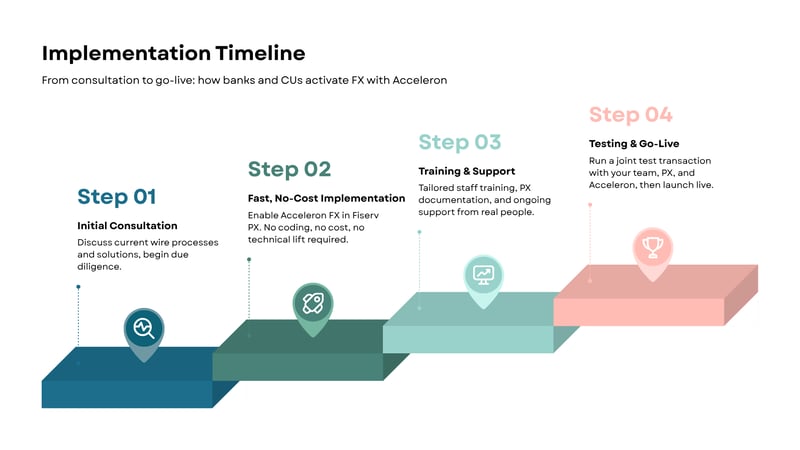
Step 1: Discovery call. A conversation about your current wire volume, correspondent relationships, and where international payment demand is coming from. This is also where a vendor should walk you through pricing, since a genuinely no-code offering typically comes with no implementation cost.
Step 2: Activation. For institutions on a platform like Fiserv PX, this means selecting the FX option from the platform's existing menu and submitting your institution's details. The vendor coordinates the technical setup with the platform provider from there, including authorization codes, revenue G/L accounts, and your FX spread rates.
Step 3: Staff training. Your operations team gets trained on the FX workflow within the platform you already use, not a separate system. This is typically a matter of days, not weeks.
Step 4: Joint testing and Go Live. Your institution, the platform provider, and the FX vendor run a test transaction together to confirm everything is configured correctly. Once testing passes, your institution can begin processing FX wires and capturing the foreign exchange fee revenue that used to go entirely to the correspondent bank at the other end of the transaction.
Ready to evaluate your options?
If your institution already uses Fiserv Payments Exchange, Aptys PayLOGICS, Pathfinder WITS, or Braid, the fastest way to find out what cross-border payment automation could look like for your team is a short discovery conversation. Acceleron helps community banks and credit unions activate FX capability without new systems, new logins, or new headcount. Reach out to talk through what a no-code implementation would look like for your institution.
Acceleron is a modern correspondent banking platform that empowers community banks and credit unions to automate international wire transfers, capture non-interest income, and compete more effectively with big banks. With a foreign exchange (FX) marketplace and currency conversion engine, Acceleron’s API-first infrastructure helps institutions turn cross-border payment flows into efficient, revenue-generating opportunities. Serving over 200 financial institutions and facilitating more than $1 billion in international payments annually, our correspondent banking services and international payment automation solutions are pre-integrated seamlessly with Fiserv Payments Exchange, Aptys, and other leading payments platforms.
Subscribe to our monthly newsletter, "The Exchange," to stay ahead of the curve and get original content and actionable insights you won't find anywhere else!
 Elizabeth Downey, COO of Acceleron

 Daisy Lin, Head of Marketing, Acceleron: 10/8/26, 11:15 AM