Common international wire failure points and how international payment automation can reduce errors to under 1%
In 1871, Western Union introduced electric money transfer through the use of telegraphs. The concept spread, went global, and eventually became one of the most critical systems in modern-day banking. And yet, even after 150 years, wire transfers are still notoriously error-prone. In fact, about a third of banks have reported that more than 31% of their international wires have mistakes.
These day-to-day errors aren’t just inconvenient; they can become expensive very quickly. Especially when you consider the time spent rekeying data, incurred fees, and the lost revenues when a wire has to be cancelled.
Benchmarking ourselves against the industry
When American Banker published this error data, we decided to evaluate how our system was doing against banking standards.
Our system’s error rate is way below 1% at .23%. Compared to 31%, you begin to see where automation makes a huge difference in accuracy. with APIs handling the heavy lifting in data exchange. The wire transfer automation system catches mistakes early, before they ever reach the FX provider. When wire instructions are entered, our system does a preliminary check to guarantee completeness and accuracy to the best of our abilities. Incomplete or mistaken fields are flagged instantly and give the wire team the opportunity to correct the mistake without delay. That said, even with .23%, we’ve seen error patterns emerge.
Common failure points in international wires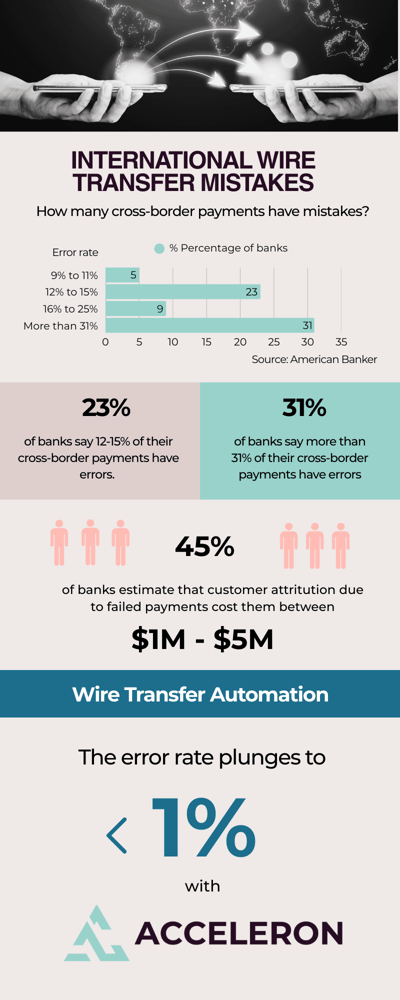
Some of the most common issues we’ve encountered include:
-
Invalid Swift/BIC Codes
-
Missing Intermediary Bank Information
-
Missing or Invalid Country-Specific Fields
-
Incorrect or Missing Beneficiary details
These aren’t just human errors; they point to a clear system error. Reducing manual data entry would significantly reduce errors all around.
Practical ways to minimize risk in everyday wire processing
However, as long as humans are entering data, errors are inevitable. A guaranteed 0% error rate isn’t realistic for anyone. But there are practical steps that can be taken to reduce the day-to-day errors. Such as:
1. Silent Rules
Staff members need to understand silent rules and fail points to prevent them from repeating the mistake. Silent rules are behind the scenes compliance checks designed to prevent money laundering, tax evasion, and terrorist financing. Many people aren’t even aware of these rules until the wire is flagged or rejected.
Examples include restriction like:
-
Addresses cannot include P.O. Boxes
-
Certain words such as urgent or immediate are discouraged
-
Higher values require additional details
2. Provide External Guidance
Wire entry isn’t just about entering data; it's about knowing what data is required. While teaching staff about the different requirements is extremely important, it's unrealistic to expect them to have all the information memorized. Especially when you consider that requirements vary by country and change all the time. Providing easily accessible resources, such as accepted currencies, country requirements, and when an intermediary bank is required, allows staff to verify information before submitting.
3. Complete the Wire While the Customer is Still Present
Whenever possible, wire instructions should be entered while the customer is still present. This ensures that a customer is available to validate information before submission and allows missing or incorrect information to be reviewed instantly.
4. Use Technology that Enforces Requirements
Wire requirements are always changing, and humans are prone to error. Having a system that checks for requirements and missing/invalid fields creates a safety net and ensures requirements stay up to date.
5. Standardized Practice
Standardizing wire intake ensures that there is no variability and that all the required information is requested, no matter who is assisting a customer.
6. Double Check before Submitting
A quick pre-check before submitting a wire can make all the difference between a good wire and an erroneous one.
Before submitting any wires make sure :
-
There are no typos or missing fields
-
Wire Instructions matches the client instructions
-
Nothing is unclear, if unclear ask for clarification
A 30 second pre check can be the difference between a successful wire and rejected or delayed transactions.
Understanding where those errors occur helps to pinpoint ways to reduce them. This is where wire transfer automation comes in.
What is wire transfer automation?
Wire transfer automation uses APIs, data validation, and rule-based controls to reduce manual entry, prevent errors, and streamline international wire processing for banks and credit unions. Without automation, wire teams are left to manage complex requirements manually. That’s where breakdowns most often occur.
A wire transfer automation system like Acceleron can help your financial institution keep up-to-date on changing requirements. Our software also performs pre-checks that flag issues the moment data is entered so that errors are automatically caught before they get sent. That’s how we help clients reduce errors down to less than 1%.
Learn more about wire transfer automation:
Lower error rates mean fewer fees and more revenue, and it also means happier clients. Clients notice when things work smoothly. It builds confidence in your system and in your staff. That trust, especially for community banks and credit unions, is irreplaceable.
Acceleron is a modern correspondent banking technology platform that empowers community banks and credit unions to automate international wire transfers, capture non-interest income, and compete more effectively with big banks. With a foreign exchange (FX) marketplace and currency conversion engine, Acceleron’s API-first infrastructure helps institutions turn cross-border payment flows into efficient, revenue-generating opportunities. Serving over 200 financial institutions and facilitating more than $1 billion in international payments annually, our correspondent banking services and international payment automation solutions are pre-integrated seamlessly with Fiserv Payments Exchange, Aptys, Braid, and other leading payments platforms.
Subscribe to our monthly newsletter, "The Exchange," to stay in the know and get original content and insights you won't find anywhere else!
 Fernanda De Oliveira Girelli, Technical Operations Specialist


 Daisy Lin, Head of Marketing, Acceleron: 10/8/26, 11:15 AM