57% of your SMB customers are already making payments abroad. Make sure it’s through you.
Every community bank and credit union I talk to says the same thing: they want more small business relationships, and they want deposits and revenue that do not depend entirely on fluctuating interest rates. What fewer of them say, but what I think about constantly, is that one of the clearest paths to both of those things is already sitting inside their existing customer base: international payments.
This isn't a niche opportunity anymore. PYMNTS Intelligence Research with Mastercard found that 57% of U.S. small businesses now source goods or materials from overseas suppliers, and that includes plenty of very small firms, not just companies with a procurement department. Among businesses doing $1 million to $10 million in revenue, that number climbs to nearly three in four. SMBs are one of the fastest-growing segments in international payments, period, with Convera projecting 12.7% annual growth through 2033. If you're a community banker and you think this doesn't touch your customer base, I'd push back on that.
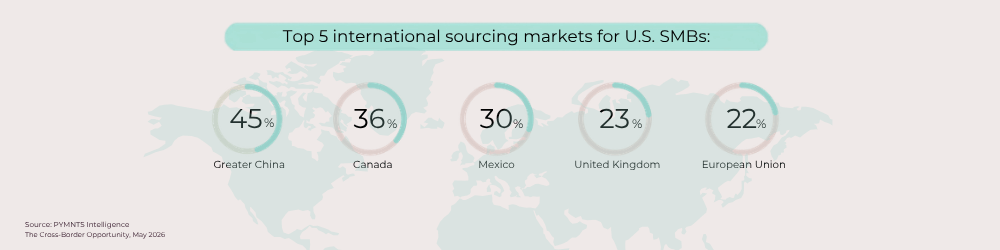
Your SMB customers are already sending money abroad
If you run a community bank or credit union, some meaningful share of your business customers are paying an overseas supplier, moving payroll to a contractor abroad, or settling an invoice in a foreign currency. Right now, a lot of that volume is not going through your community FI. It is going through a fintech, a money transfer app, or a bigger bank down the street that has the infrastructure to handle it. Every one of those payments is non-interest income your FI is not capturing, and every one of them is a small reminder to that customer that they need another vendor for part of their banking relationship.
The numbers back this up. PYMNTS and Mastercard found that 69% of internationally active SMBs are expected to use traditional banks for cross-border supplier payments in 2026. At the same time, SMBs planning to use fintechs or specialist payment providers for cross-border purchases grew from 30% in 2025 to 36% in 2026. So while banks still hold the relationship today, that share is moving every year.
That is the part I would push community bankers to sit with. It is not just a missed fee. It is a wedge. Once a business customer builds a habit of using another provider for something as central as moving money internationally, you have opened the door for that provider to win more of the relationship over time. This is exactly the gap that cross-border payments solutions for community banks are meant to close, not by turning your bank into something it is not, but by giving you the infrastructure to keep that volume where it belongs.
Bringing FX in house does two things at once
When a bank turns on in-house international payment capability, two things happen right away. First, you capture revenue you were not getting before. If your SMB customers are already sending international payments through someone else, bringing that volume in house is new non-interest income, full stop. If you are already offering it but routing it through an expensive correspondent, you are probably leaving rate competitiveness on the table. Running that volume through a marketplace where multiple correspondent banks are competing for the transaction ensures that your customers are getting a better rate, and strengthens the relationship. That is the value of correspondent banking software built for this specific job, rather than a general payments system with FX bolted on.
Read more about how an FX marketplace drives pricing down and builds redundancy:
Second, and this is the part I think gets undervalued, you reduce friction for the customer, while providing them with better rates and service. If your SMB customer can't get a fast, fairly priced international payment through you, they will open an account with a money transfer app or a standalone fintech to get it done, and once that habit forms, some of that relationship may never come back. Keeping the transaction inside your bank means the customer never has to open another platform, reconcile a second set of records, or explain a new vendor to their accounting team, it's simply more convenient, and it keeps their books in one place.
Automation also changes what you can offer them once you're not manually re-keying wire details between systems on your own end. Manual, multi-step processing is hard to quote accurately and even harder to track in real time, so it tends to come with vague timelines and fees the customer only discovers after the fact. Cutting out that dual entry is what makes it possible to give the customer real transparency, a locked rate, disclosed fees, and visibility into where the payment is, before they ever hit send. Wire transfer automation for banks and CUs is what makes that possible.
The customers you want next expect this by default
If you want to attract the next generation of business customers, you have to think about what they expect walking in the door, and the data on this is pretty stark. A Datos Insight / Apiture survey on next-generation business owners found that 44% of millennial and Gen Z-led businesses are already considering switching financial institutions within two years, and half of millennial-run businesses say they would switch institutions for better payment options alone, not bundled digital banking generally, payment options specifically.
A new business owner is not going to tolerate a clunky, manual international payments process. They want something that feels like the tools they already use. If you cannot offer that, you are telling them to go find another bank or payments platform that can, and the data says they will.
This is not about chasing every fintech trend. It is about recognizing that "tech forward" is no longer a nice to have for community financial institutions, it is table stakes for winning and keeping the business accounts that actually grow. The same survey found that 55% of millennial-run small businesses would still prefer a community bank if it offered comparable digital capabilities to a larger institution. The relationship isn't lost, it just has to be earned with the right infrastructure.
How we built Acceleron to close this gap
This is exactly the problem we set out to solve. We built Acceleron because community banks and credit unions needed a way to offer efficient, cost-effective international payments without taking on the cost, compliance burden, and years of infrastructure-building it would take to do it themselves.
Our correspondent banking software powers an FX marketplace where multiple correspondent banks bid on each transaction, so your institution gets a competitive rate on every wire instead of a single take-it-or-leave-it price, and our clients have seen rates improve by as much as 50% as a result.
That same connected system is what fixes the operational side most banks don't think to measure: manual and dual entry. When a wire is entered once in a single system and flows straight through to settlement instead of getting keyed in twice across two disconnected systems, you eliminate the re-entry errors that cause returned payments, delayed settlement, and reconciliation headaches at month end. You also can give customer disclosures on the spot. In addition, our system, built to validate against each destination's specific requirements before a wire is ever submitted, keeps the error rate under 1%, in contrast to the more than 31% of international wires errors that occur industry-wide.
Read our case study with Legacy Bank:
None of this requires you to build an in-house FX desk, hire international payments specialists, or manage compliance for cross-border transactions on your own. We handle that layer so you can offer the capability under your own name, keep the relationship, and capture the non-interest income, without the build.
Why this matters more for community banks, not less
Big banks already do this well enough, but it comes at a price the customer feels: higher fees, slower service, and none of the relationship banking that got them there in the first place. Community banks and credit unions have the opposite problem. You already have the trust and the local relationships that big banks spend fortunes trying to manufacture. What you've been missing is the payments infrastructure to back it up, and the correspondent bank relationships to move money quickly once it leaves your walls.
Closing that gap doesn't mean becoming a different kind of institution. It means giving the relationship banking model you already have a payments experience that actually matches it: fast, transparent, and competitively priced, so a customer never has a reason to go looking for something this basic somewhere else. And because modern correspondent banking software plugs into the systems you're already running, there's little tech lift required to get there.
This isn't a hypothetical opportunity. It's already showing up in how business owners choose and leave their banks. The institutions that treat international payments as core to the SMB relationship, not an afterthought, are the ones that will keep those customers as they scale, and the ones that will win the next generation of business owners who won't settle for anything less.
Acceleron is a modern correspondent banking platform that empowers community banks and credit unions to automate international wire transfers, capture non-interest income, and compete more effectively with big banks. With a foreign exchange (FX) marketplace and currency conversion engine, Acceleron’s API-first infrastructure helps institutions turn cross-border payment flows into efficient, revenue-generating opportunities. Serving over 200 financial institutions and facilitating more than $1 billion in international payments annually, our correspondent banking services and international payment automation solutions are pre-integrated seamlessly with Fiserv Payments Exchange, Aptys, and other leading payments platforms.
Subscribe to our monthly newsletter, "The Exchange," to stay ahead of the curve and get original content and actionable insights you won't find anywhere else!
 Damon Magnuski, CEO, Acceleron


-1.png)

 Daisy Lin, Head of Marketing, Acceleron: 9/29/26, 9:10 AM

 Elizabeth Downey, COO of Acceleron