International wire automation, stablecoins, wallets, and AI reshape global money movement
What a pivotal year in cross-border payments. No one expected stablecoins to move so quickly into the regulatory mainstream. SWIFT modernized its infrastructure with blockchain and artificial intelligence. And the long-awaited ISO 20022 migration finally went live across major global rails, ushering in a new era of richer data.
At the same time, geopolitical shifts continued to reshape how consumers and businesses move money across borders. Community banks and credit unions faced growing pressure to modernize, automate, and diversify correspondent banking relationships while capturing more non-interest income from international transactions.
Here are the major global developments and innovations in correspondent banking that defined the year, and what they mean for 2026.
Global payments revenue still growing
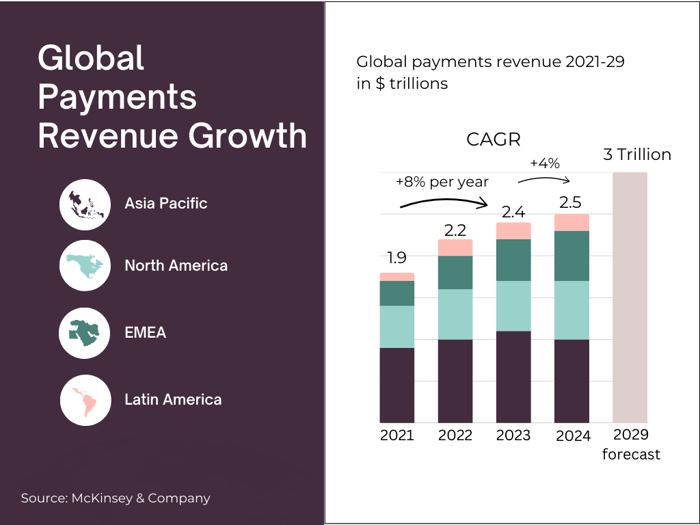
The global payments industry continued to grow, though at a slower pace than in the past two years. According to McKinsey, global payments revenue rose about 4 percent in 2024, down from 8 percent per year in the previous 3 years, due to softer macro conditions, fee pressure, and a shift toward lower-yield payment methods. Latin America led with double-digit growth, while Asia Pacific declined slightly.
Despite the deceleration, payments remain one of the most valuable sectors in finance. Revenues are expected to reach 3 trillion dollars by 2029, with cross-border ecommerce, real-time payments, and digital wallets driving much of the momentum. For smaller institutions, the message is simple: global payments continue to grow, and the question is how much of that value they can capture.
Regional cross-border payment developments
North America
North America advanced rapidly toward digital money and modern payment infrastructure. The GENIUS Act provided the first federal framework for stablecoins, prompting banks, card networks, and fintechs to accelerate digital payment pilots. Visa, Stripe, PayPal, and Zelle all began testing stablecoin-based settlement for cross-border transactions. Fedwire completed its ISO 20022 migration in July, incorporating richer, structured data into every payment and prompting banks to modernize their manual workflows. Meanwhile, tariff volatility increased demand for flexible FX and cross-border financing options. For community financial institutions, 2025 highlighted the urgency of modernizing correspondent functions and networks while automating international wire processing.
Europe
Europe continued setting the global pace on regulation and real-time payments. The EU’s Instant Payments Regulation came into force, requiring all eurozone banks to receive instant payments and to send them by the end of 2025. The European Central Bank advanced the digital euro toward a 2027 pilot, and major European banks formed the Qivalis consortium to launch a regulated euro stablecoin. Across the Single Euro Payments Area (SEPA), instant account-to-account (A2A) payments have been mandated and broadly adopted under the 2025 Instant Payments Regulation, paving the way for broader wallet-style and real-time euro transfers.
Asia Pacific
Asia Pacific remained the world leader in wallet-based payments, instant payment networks, and CBDC experimentation. China launched a Digital Yuan Innovation Center focused on cross-border trade and digital asset platforms. India strengthened its already dominant payments presence, granting PayPal approval as a cross-border payment aggregator and deepening UPI connectivity with global networks. Cross-border payment and wallet providers such as Thunes, Alipay Plus, and Payoneer expanded real-time payout corridors across the region. APAC’s blend of scale, regulatory support, and digital-first consumer behavior continued to drive global innovation in cross-border payment flows.
Latin America
Latin America saw accelerating fintech expansion and regulatory modernization. Revolut received approval to operate as a digital bank in Mexico, adding new competition in SME cross-border payments. Partnerships such as LoanPro and NovoPayment focused on boosting credit access in the region. PayPal expanded wallet interoperability through Mercado Pago. Brazil’s Pix — a central bank–run instant payment system enabling real-time, account-to-account transfers — has emerged as a regional benchmark, influencing how neighboring countries approach the development of their own real-time payment networks. With remittances at record levels, the region invested heavily in APIs, FX infrastructure, and digital rails that reduce settlement friction across borders.
Middle East
The UAE emerged as a regional pioneer in CBDCs with the rollout of the Digital Dirham, with ongoing plans for wholesale and cross‑border use over the mBridge CBDC platform. Mobile wallets and digital remittance apps also surged in popularity across the Gulf, especially in the UAE, where a 2025 report from Visa found that nearly two‑thirds of remitters now prefer digital apps over traditional cash or bank transfer methods. Mastercard and UAE-based fintech Zand expanded cross-border payout options across multiple countries,
Africa
Africa entered a transformative growth phase as cross-border payment volume is projected to more than triple over the next decade, from $329 billion in 2025 to a projected $1 trillion by 2035. Several regional and pan-African initiatives, including new instant payment systems (IPS) and regional settlement frameworks like PAPSS, are underway, especially in the context of the African Continental Free Trade Area. As a result, many analysts now see Africa not just as a mobile-money market, but as one of the world’s most promising frontiers for cross-border payments growth.
SWIFT modernizes global correspondent banking infrastructure
SWIFT accelerated its modernization agenda in 2025, building on the industry-wide transition to ISO 20022 and expanding beyond messaging into real-time transparency, blockchain connectivity, and shared intelligence. As the November 2025 end of MT coexistence approached, SWIFT rolled out new ISO 20022 capabilities that improve data quality, reduce investigations, and make real-time tracking and wire transfer automation possible across correspondent networks.
Key developments included:
-
Real-time tracking and transparency
SWIFT introduced major upgrades to its cross-border payments platform, offering banks white-labeled tools that give customers real-time visibility into international wire transfers — a significant step toward predictable, end-to-end payment experiences.
-
Blockchain interoperability with Chainlink
SWIFT partnered with Chainlink to connect financial institutions to blockchain networks, enabling banks to interact with on-chain assets and settlement systems.
-
Shared global ledger initiative
In partnership with global banks, SWIFT began developing a shared blockchain-based ledger designed to support regulated tokenized value transfers around the clock, signaling a long-term shift toward 24/7 cross-border settlement infrastructure.
-
AI-powered fraud detection with Google Cloud
SWIFT and Google Cloud launched a federated learning initiative, which is a way to train artificial intelligence (AI) models without others seeing your data, to strengthen cross-border fraud detection while preserving privacy.
Together, these advancements position SWIFT as a modern, interoperable infrastructure provider. For smaller institutions, these changes raise expectations: tracking, transparency, and speed are no longer fintech-only features. They are becoming the baseline for modern cross-border wires.
Read our ISO 20022 guide for community FIs:
International payment automation becomes essential infrastructure
As ISO 20022 went live and expectations for speed and accuracy increased, 2025 became a turning point for international payment automation. Manual entry, template errors, and fragmented correspondent account processes grew harder to sustain, pushing community banks and credit unions to adopt wire transfer automation solutions that reduce repairs, streamline settlement, and free up staff time.
Acceleron expanded its role as an international payment automation partner through deeper integrations with major payments platforms:
- Fiserv Payments Exchange (PX)
Acceleron’s FX marketplace and wire transfer automation solutions were pre-integrated into PX: Foreign Exchange Services, giving institutions automated validations, enriched ISO 20022 data, multi-bank FX pricing, and straight-through processing, with minimal technical lift and quick integration.
- Aptys PayLOGICS
The integration with Aptys allows banks to route wires through Acceleron’s SmartRoute and NudgeConvert systems to improve pricing, reduce exceptions, and automate end-to-end settlement.
- Braid Core
Through a single API, Braid clients can access Acceleron’s FX marketplace and automated compliance and settlement tools, enabling even smaller institutions to offer modern cross-border payment capabilities without additional infrastructure.
Together, these partnerships reflect a broader industry shift: international wires are moving from manual back-office work to automated, revenue-generating workflows that help community banks stay competitive and retain more income from global payments.
Digital assets and stablecoins go mainstream
Stablecoins moved decisively into regulated financial services this year, transforming from a niche innovation into a serious cross-border settlement tool. In the United States, the GENIUS Act created the first federal framework for issuing and supervising dollar-backed stablecoins. That clarity sparked a wave of institutional initiatives: Visa expanded its stablecoin settlement pilots for cross-border payouts; Stripe’s Bridge platform enabled fintechs to route international payments using USDC; Zelle announced plans to support stablecoin-powered cross-border settlement as it expands internationally; and PayPal broadened access to PYUSD across more countries and wallet ecosystems. Meanwhile, top banks in the U.S., including Bank of America, Citibank, Wells Fargo, and JPMorgan Chase, are teaming up to issue stablecoins through a joint venture.
For community financial institutions, the takeaway is not that everyone must issue a token. It is that the settlement layer of global payments is changing. As more cross-border transactions move across tokenized rails, correspondent banks and technology partners will serve as the bridge between traditional ledgers and digital settlement networks, ensuring community banks can participate in the next era of global payments rather than be sidelined by it.
What this means for community banks and credit unions in 2026
Across every region, cross-border payments are becoming faster, more transparent, more competitive, and more digitally enabled. For community banks and credit unions, 2026 will be defined by these strategic imperatives:
1. Capture non-interest bank revenue from FX and global payments
As spreads tighten and competition intensifies, smaller institutions cannot afford to give away FX revenue to foreign correspondent banks. Access to FX marketplaces and automated currency conversion tools helps banks retain more income and offer better pricing to customers.
Read our article about capturing non-interest income from international payments:
2. Modernize the wire process
ISO 20022 has raised the bar for data quality and process consistency. Institutions relying on manual workflows will face higher error rates and slower investigations. Automation is becoming essential for delivering predictable, accurate international payments.
Read more about international wire automation:
3. Diversify correspondent banking relationships
New global rails, tokenized settlement pilots, and geopolitical shifts make single-provider dependency riskier. Multiple correspondent relationships improve resilience, pricing, routing options, and customer transparency.
Read more about working with multiple correspondent banks:
4. Learn and stay ahead of digital asset developments
With tokenized deposits, stablecoins, and new settlement models entering the regulated mainstream, bankers do not need to adopt these technologies immediately, but they do need to understand them. Asking the right questions now, monitoring regulatory frameworks, and exploring safe, low-risk pilot opportunities will help institutions prepare without overcommitting.
Future of correspondent banking and cross-border payments
2025 marked the transition to a new era of global payments defined by structured ISO data, real-time networks, wallet-driven commerce, and the emergence of tokenized settlement. For community banks and credit unions, the path forward is clear: automate intelligently, partner strategically, and stay informed about evolving digital payment models. Institutions that invest early in modern infrastructure will deliver faster, more reliable, more transparent international payments and capture the revenue opportunities that come with them.
Acceleron is a modern correspondent banking technology platform that empowers community banks and credit unions to automate international wire transfers, capture non-interest income, and compete more effectively with big banks. With a foreign exchange (FX) marketplace and currency conversion engine, Acceleron’s API-first infrastructure helps institutions turn cross-border payment flows into efficient, revenue-generating opportunities. Serving over 200 financial institutions and facilitating more than $1 billion in international payments annually, our correspondent banking services and international payment automation solutions are pre-integrated seamlessly with Fiserv Payments Exchange, Aptys, Braid, and other leading payments platforms.
Subscribe to our monthly newsletter, "The Exchange," to stay in the know and get original content and insights you won't find anywhere else!
 Daisy Lin, Head of Marketing, Acceleron
.png)

-1.png)



 Daisy Lin, Head of Marketing, Acceleron: 10/8/26, 11:15 AM